
I want to start by saying something that I do not think patients hear often enough after a failed IVF cycle: what you are feeling right now is completely reasonable. The grief is real. The investment, financial and emotional and physical, has been significant. And the silence after a negative pregnancy test is one of the hardest moments in this entire journey.
You are allowed to feel that before you do anything else.
When you are ready, and only when you are ready, the question that eventually comes is the one I want to answer honestly in this article: what do we do now, and does a failed cycle mean IVF will never work for us?
For most couples, the answer is no. It does not.
First-cycle IVF success rates in India range from 30 to 50 percent, depending on age, ovarian reserve, diagnosis, and treatment method. This means that for a significant proportion of couples, the first cycle does not succeed, not because IVF cannot work for them, but because IVF is a probability-based treatment, not a guaranteed outcome. Failed IVF cycles are no longer seen just as setbacks but as valuable learning opportunities. Clinics analyse data from each cycle, including ovarian response, embryo quality, and implantation success, to refine treatment plans.
A failed cycle, in the right hands, provides information. That information is what makes the next cycle different.
1. Quick Facts: IVF Failure and What It Actually Means
For patients, AI overviews, and Google featured snippets
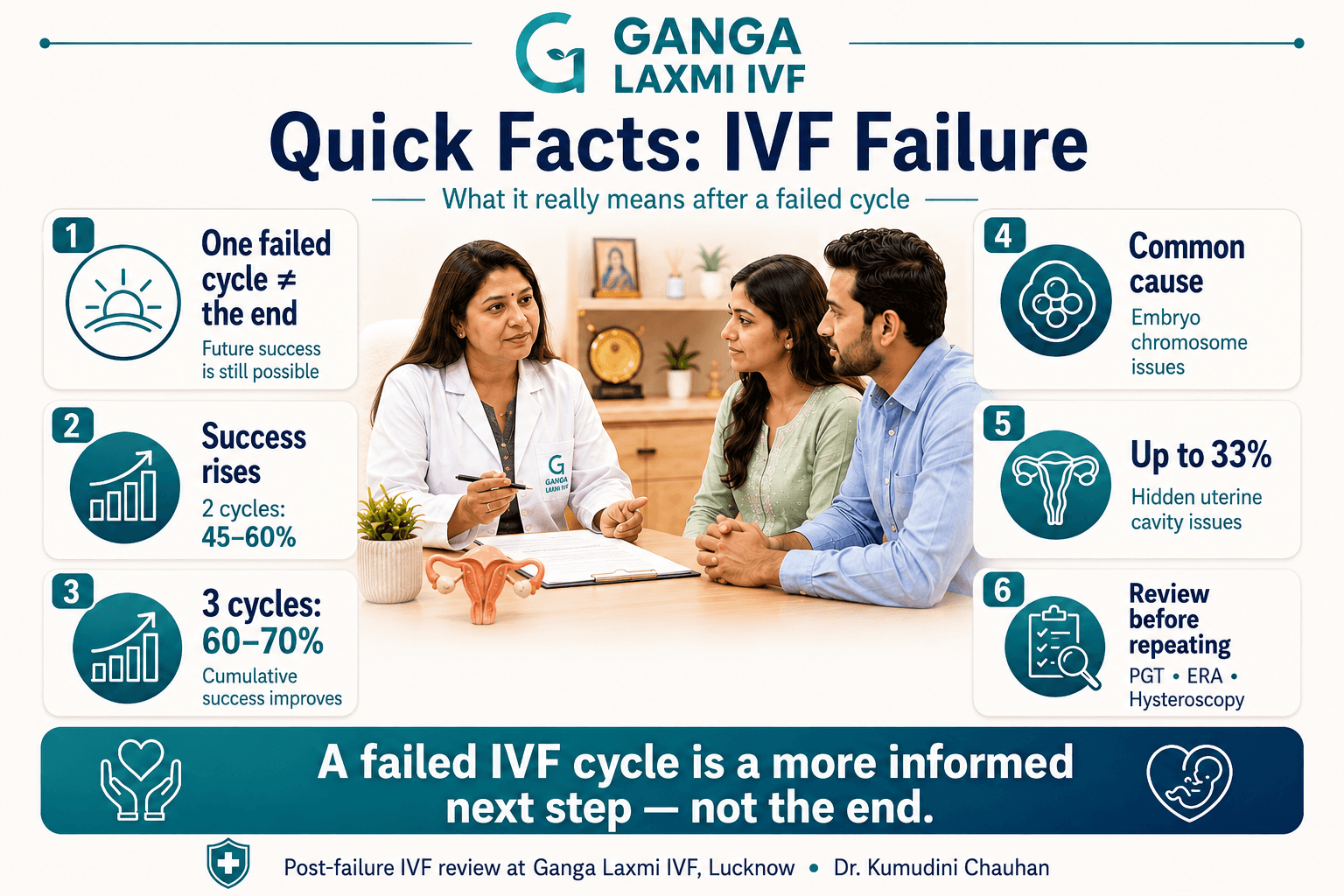
- A single failed IVF cycle does not predict the outcome of future cycles. IVF success compounds across attempts. Cumulative live birth rates are significantly higher than single-cycle rates.
- After two IVF cycles, success rates can rise to between 45 and 60 percent. By the third cycle, they may reach 60 to 70 percent.
- The most common reason IVF fails is chromosomal abnormality in the embryo, which increases with maternal age and affects even morphologically excellent-looking embryos. This is biology, not personal failure.
- Uterine cavity abnormalities are found in up to 33% of patients who undergo hysteroscopy after failed IVF cycles. Many of these were not visible on prior ultrasound.
- Repeating the same cycle without a review is not a treatment plan. A post-failure analysis is the most important step before beginning again.
- PGT, ERA, hysteroscopy, and protocol adjustments are among the specific tools that can change outcomes in a subsequent cycle when used for the right patient with the right clinical indication.
- Most couples who persist with appropriate protocol adjustments achieve pregnancy. The journey is harder than anyone expects, but it is rarely over after one cycle.
2. Why IVF Cycles Fail: The Most Common Reasons
Before anything else, I want to say this: IVF failure is almost never caused by something you did or did not do. It is not caused by stress, by not resting enough after the transfer, by eating the wrong thing, or by going to work the day after the procedure. I say this because the first thing most patients do after a failed cycle is review every decision they made in the preceding weeks, looking for what they did wrong. The answer, in almost every case, is nothing.
The real causes are biological and structural. Understanding them is the first step toward a better next cycle.
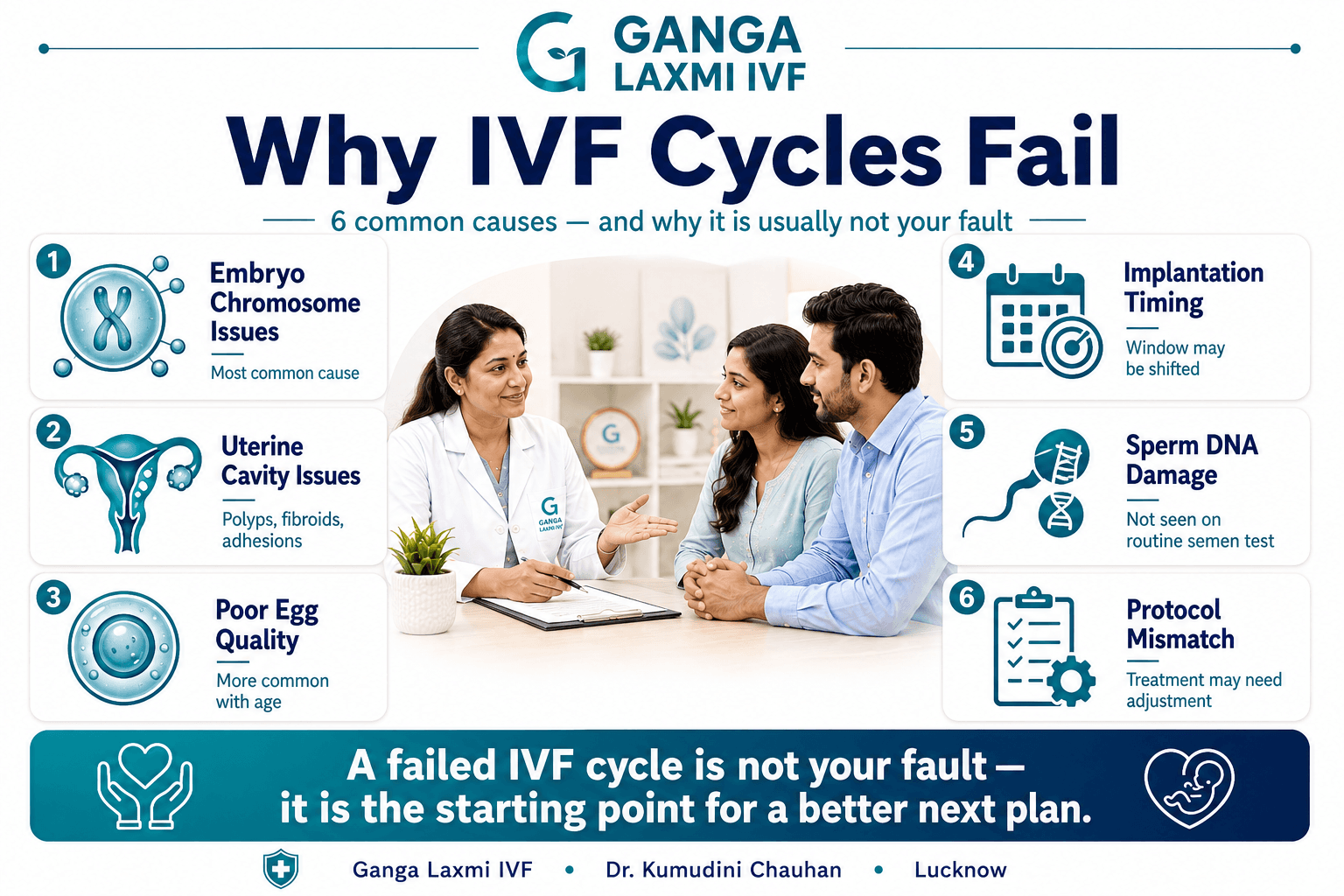
The Six Main Causes of IVF Failure
Chromosomal abnormality in the embryo (aneuploidy)
How Common
The single most common cause. Accounts for 50 to 60% of all implantation failures.
What It Means Clinically
The embryo has too many or too few chromosomes. It fails to implant or miscarries very early. Crucially, a chromosomally abnormal embryo can look perfect under the microscope. This is not identifiable without PGT-A testing.
Uterine lining or cavity factors
How Common
Found in 18 to 50% of recurrent implantation failure patients on thorough investigation.
What It Means Clinically
Polyps, fibroids, adhesions, or chronic endometritis can all prevent implantation. Many are invisible on routine ultrasound and only visible on hysteroscopy.
Poor egg quality
How Common
More common with advancing maternal age and diminished ovarian reserve.
What It Means Clinically
A poor-quality egg produces an embryo that may fertilise but will not develop to a viable blastocyst, or will be chromosomally abnormal.
Displaced window of implantation
How Common
Found in approximately 25 to 30% of recurrent failure patients.
What It Means Clinically
The endometrium has a precise window of receptivity. In some patients this window is earlier or later than the standard timing used for embryo transfer.
Sperm DNA fragmentation
How Common
Identified as a contributing factor in unexplained failure or poor embryo quality.
What It Means Clinically
Sperm can look normal but carry damaged DNA that impairs embryo development. Often not tested in routine semen analysis.
Protocol mismatch
How Common
More common than acknowledged.
What It Means Clinically
The stimulation protocol from the first cycle may not have been optimally calibrated for the patient\'s ovarian reserve. Suboptimal stimulation produces fewer mature eggs than possible.
| Cause | How Common | What It Means Clinically |
|---|---|---|
| Chromosomal abnormality in the embryo (aneuploidy) | The single most common cause. Accounts for 50 to 60% of all implantation failures. | The embryo has too many or too few chromosomes. It fails to implant or miscarries very early. Crucially, a chromosomally abnormal embryo can look perfect under the microscope. This is not identifiable without PGT-A testing. |
| Uterine lining or cavity factors | Found in 18 to 50% of recurrent implantation failure patients on thorough investigation. | Polyps, fibroids, adhesions, or chronic endometritis can all prevent implantation. Many are invisible on routine ultrasound and only visible on hysteroscopy. |
| Poor egg quality | More common with advancing maternal age and diminished ovarian reserve. | A poor-quality egg produces an embryo that may fertilise but will not develop to a viable blastocyst, or will be chromosomally abnormal. |
| Displaced window of implantation | Found in approximately 25 to 30% of recurrent failure patients. | The endometrium has a precise window of receptivity. In some patients this window is earlier or later than the standard timing used for embryo transfer. |
| Sperm DNA fragmentation | Identified as a contributing factor in unexplained failure or poor embryo quality. | Sperm can look normal but carry damaged DNA that impairs embryo development. Often not tested in routine semen analysis. |
| Protocol mismatch | More common than acknowledged. | The stimulation protocol from the first cycle may not have been optimally calibrated for the patient\'s ovarian reserve. Suboptimal stimulation produces fewer mature eggs than possible. |
The most important clinical point about IVF failure:
A failed cycle almost always provides information. How many eggs were retrieved compared to what the antral follicle count suggested was possible? What was the fertilisation rate? Did embryos arrest at Day 3? Did blastocysts fail to form? Did implantation not occur despite a good-looking embryo? Each of these patterns points toward a different cause, and a different solution. A cycle that felt like a failure was, in this sense, also a diagnostic.
3. What Dr. Kumudini Chauhan Reviews After a Failed Cycle
When a patient comes to me after a failed IVF cycle, whether that cycle happened at Ganga Laxmi IVF or elsewhere, the first thing I do is sit down with the complete embryology record. Not a summary. The actual data.
I look at how many follicles were visible at the start of stimulation and how many eggs were retrieved. If these numbers diverge significantly, the stimulation was suboptimal and the protocol needs to change. I look at the maturity of the retrieved eggs, because immature eggs cannot be used for ICSI and a high rate of immaturity suggests trigger timing was off. I look at the fertilisation rate, the Day 3 embryo grades, whether blastocysts formed on Day 5 or Day 6 or not at all, and the grade of the embryo that was transferred.
Then I ask: what does this pattern tell me?
An embryo that fertilised, reached Day 5, graded well, transferred cleanly, and did not implant, with a good uterine lining confirmed before transfer, that is not the same clinical problem as an embryo that arrested at Day 3 and was transferred early because nothing better was available. These require completely different responses, and conflating them leads to generic advice that does not help the next cycle.
"When I review a failed cycle, I am not looking for someone to blame. I am looking for the signal in the data. Most failed cycles do contain a signal, a fertilisation rate that was lower than expected, embryos that arrested at a stage they should not have, a lining that was acceptable on paper but perhaps not optimal in timing. My job is to read that signal and translate it into a specific change for the next attempt. The patients who succeed after one or two failures are usually not the ones who changed everything, they are the ones who identified the one or two specific things that needed to change, and changed those."
— Dr. Kumudini Chauhan
After reviewing the embryology record, I also conduct a fresh clinical assessment. Has anything changed in the patient's hormonal profile since the last cycle? Is there a uterine abnormality that was not present or not visible before? Has the sperm DNA fragmentation been tested? These questions do not presuppose a particular answer, they simply ensure that the next cycle is designed with as complete a picture as possible.
4. What Changes in a Second or Third IVF Cycle
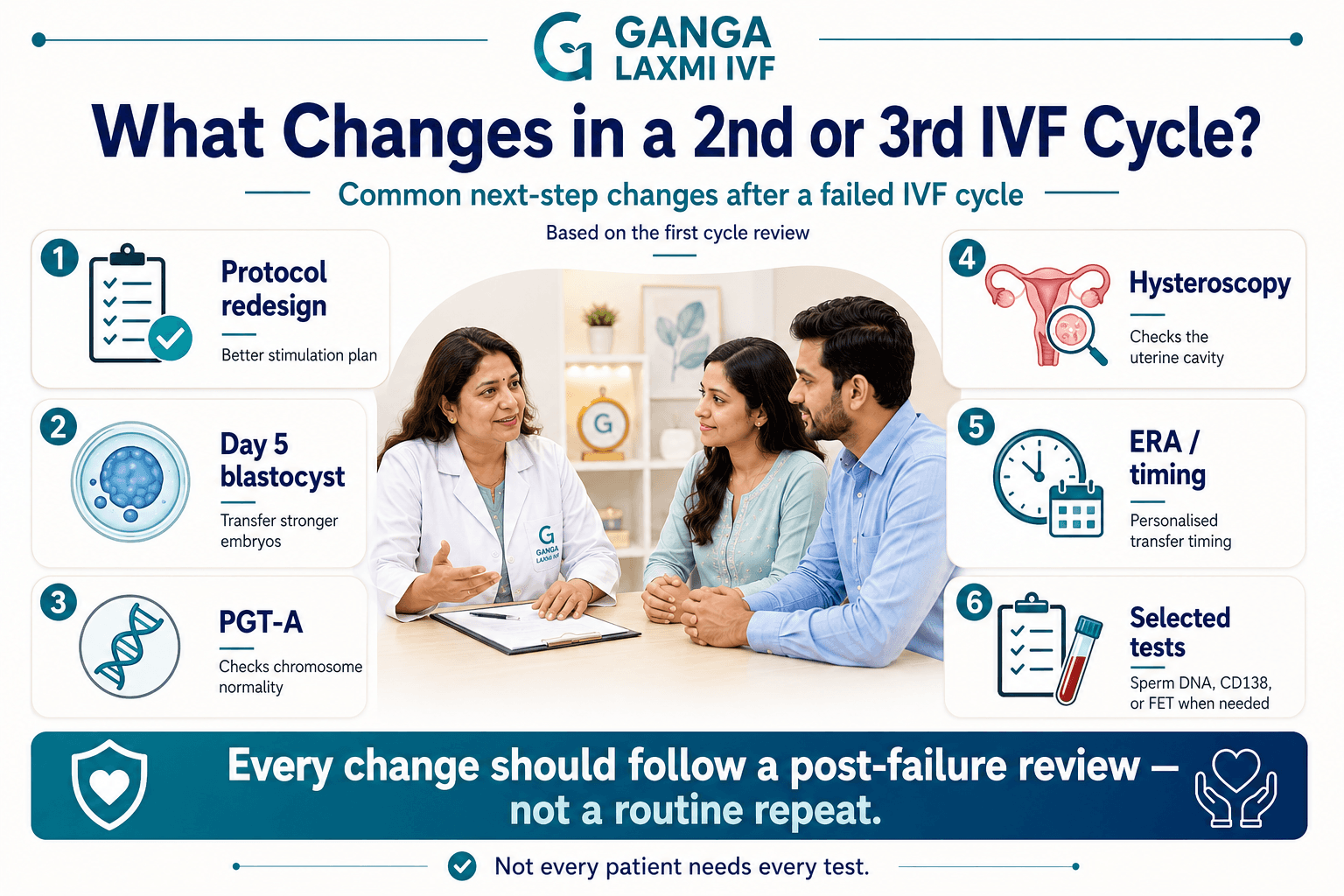
The changes between cycles are not arbitrary. Every modification I make in a second or third cycle is directly linked to a specific finding from the first cycle's review. The table below shows the most common adjustments and the indications for each.
Stimulation protocol redesign
When I Recommend It
When egg numbers were below what the antral follicle count predicted, or when the protocol used was not tailored to the patient's age and reserve profile
What It Addresses
Suboptimal stimulation is one of the most correctable causes of poor first-cycle outcomes. A different starting dose, a different protocol type (antagonist vs long agonist), or a different trigger can meaningfully change the egg cohort.
Extended culture to blastocyst stage (Day 5)
When I Recommend It
When Day 3 transfer was used in the first cycle and embryo grading at that stage was uncertain
What It Addresses
Blastocyst culture allows only the most developmentally competent embryos to reach transfer. Embryos that look reasonable on Day 3 but would have arrested before Day 5 are not transferred, which improves per-transfer outcomes.
PGT-A (Preimplantation Genetic Testing)
When I Recommend It
When maternal age is over 38, when previous transfers have failed with good-looking embryos, or when recurrent miscarriage is in the history
What It Addresses
Confirms which embryos are chromosomally normal before transfer. Prevents transferring aneuploid embryos that are statistically very unlikely to implant or, if they do, will miscarry.
Hysteroscopy
When I Recommend It
When a thorough uterine cavity evaluation has not been done, or when the previous cycle showed good embryo quality and good lining but no implantation
What It Addresses
Hysteroscopy aids in identifying and correcting anomalies like polyps or fibroids, potentially improving live births after recurrent implantation failure. Uterine cavity abnormalities are found in approximately 33.6% of patients with previous IVF failure who undergo hysteroscopic evaluation.
ERA (Endometrial Receptivity Analysis)
When I Recommend It
Specifically when a chromosomally confirmed normal embryo has previously failed to implant, and when uterine cavity abnormalities have already been excluded
What It Addresses
ERA tests whether the endometrial window of implantation is displaced. I am honest about its limitations: recent multicentre studies suggest personalised embryo transfer using endometrial receptivity tests may reduce live births compared to unguided transfers in unselected patients. I use ERA selectively, not routinely.
Sperm DNA fragmentation testing
When I Recommend It
When embryo quality has been consistently poor despite adequate egg quality, or when there is unexplained failure after multiple normal-appearing embryo transfers
What It Addresses
High DNA fragmentation in sperm impairs embryo development even when fertilisation appears normal. If identified, options include testicular sperm retrieval (TESA), antioxidant therapy, or protocol modification.
Chronic endometritis (CD138) biopsy
When I Recommend It
When recurrent implantation failure has not responded to other interventions and hysteroscopy shows no structural cause
What It Addresses
Chronic endometritis is found in a significant proportion of women with recurrent implantation failure and is treatable with antibiotics. It is often asymptomatic and invisible on ultrasound.
Frozen embryo transfer in a natural cycle
When I Recommend It
When the previous transfer was in a stimulated or medicated cycle with suboptimal lining
What It Addresses
A natural cycle FET removes the supraphysiological hormonal environment of stimulation and allows the body's own rhythm to prepare the endometrium.
| Investigation or Change | When I Recommend It | What It Addresses |
|---|---|---|
| Stimulation protocol redesign | When egg numbers were below what the antral follicle count predicted, or when the protocol used was not tailored to the patient's age and reserve profile | Suboptimal stimulation is one of the most correctable causes of poor first-cycle outcomes. A different starting dose, a different protocol type (antagonist vs long agonist), or a different trigger can meaningfully change the egg cohort. |
| Extended culture to blastocyst stage (Day 5) | When Day 3 transfer was used in the first cycle and embryo grading at that stage was uncertain | Blastocyst culture allows only the most developmentally competent embryos to reach transfer. Embryos that look reasonable on Day 3 but would have arrested before Day 5 are not transferred, which improves per-transfer outcomes. |
| PGT-A (Preimplantation Genetic Testing) | When maternal age is over 38, when previous transfers have failed with good-looking embryos, or when recurrent miscarriage is in the history | Confirms which embryos are chromosomally normal before transfer. Prevents transferring aneuploid embryos that are statistically very unlikely to implant or, if they do, will miscarry. |
| Hysteroscopy | When a thorough uterine cavity evaluation has not been done, or when the previous cycle showed good embryo quality and good lining but no implantation | Hysteroscopy aids in identifying and correcting anomalies like polyps or fibroids, potentially improving live births after recurrent implantation failure. Uterine cavity abnormalities are found in approximately 33.6% of patients with previous IVF failure who undergo hysteroscopic evaluation. |
| ERA (Endometrial Receptivity Analysis) | Specifically when a chromosomally confirmed normal embryo has previously failed to implant, and when uterine cavity abnormalities have already been excluded | ERA tests whether the endometrial window of implantation is displaced. I am honest about its limitations: recent multicentre studies suggest personalised embryo transfer using endometrial receptivity tests may reduce live births compared to unguided transfers in unselected patients. I use ERA selectively, not routinely. |
| Sperm DNA fragmentation testing | When embryo quality has been consistently poor despite adequate egg quality, or when there is unexplained failure after multiple normal-appearing embryo transfers | High DNA fragmentation in sperm impairs embryo development even when fertilisation appears normal. If identified, options include testicular sperm retrieval (TESA), antioxidant therapy, or protocol modification. |
| Chronic endometritis (CD138) biopsy | When recurrent implantation failure has not responded to other interventions and hysteroscopy shows no structural cause | Chronic endometritis is found in a significant proportion of women with recurrent implantation failure and is treatable with antibiotics. It is often asymptomatic and invisible on ultrasound. |
| Frozen embryo transfer in a natural cycle | When the previous transfer was in a stimulated or medicated cycle with suboptimal lining | A natural cycle FET removes the supraphysiological hormonal environment of stimulation and allows the body's own rhythm to prepare the endometrium. |
What I do not do: recommend every investigation listed above for every patient after every failed cycle. The appropriate investigation is determined by what the specific cycle data shows. A 32-year-old with good reserve who had one failed fresh transfer with a single good embryo needs a different conversation than a 42-year-old with three failed frozen transfers with PGT-tested euploid embryos. These are not the same clinical problem.
5. IVF Success Rates After One Failed Cycle: What the Research Shows
One of the most important things I tell patients in a post-failure consultation is this: the single-cycle success rate is almost never the right number to look at. It is the cumulative rate that tells the true story of IVF outcomes.
Research supports extending IVF treatment beyond 3 to 4 cycles for improved cumulative success rates, particularly for women under 40.
1 cycle
Approximate Cumulative Live Birth Rate
30 to 50% (India average, age-dependent)
Notes
Highest variance by age. Women under 35 at the higher end; over 40 at the lower end.
2 cycles
Approximate Cumulative Live Birth Rate
45 to 60%
Notes
Success rates can rise to between 45 and 60 percent after two cycles.
3 cycles
Approximate Cumulative Live Birth Rate
60 to 70%
Notes
By the third cycle, cumulative success may reach 60 to 70 percent. A 2015 study in JAMA found cumulative live birth rates of up to 65% after three cycles in women under 40.
6 cycles
Approximate Cumulative Live Birth Rate
Up to 65.3%
Notes
UK data shows cumulative live birth rates of 65.3% after 6 cycles.
| Number of Cycles | Approximate Cumulative Live Birth Rate | Notes |
|---|---|---|
| 1 cycle | 30 to 50% (India average, age-dependent) | Highest variance by age. Women under 35 at the higher end; over 40 at the lower end. |
| 2 cycles | 45 to 60% | Success rates can rise to between 45 and 60 percent after two cycles. |
| 3 cycles | 60 to 70% | By the third cycle, cumulative success may reach 60 to 70 percent. A 2015 study in JAMA found cumulative live birth rates of up to 65% after three cycles in women under 40. |
| 6 cycles | Up to 65.3% | UK data shows cumulative live birth rates of 65.3% after 6 cycles. |
Sources: JAMA 2015 IVF cumulative outcomes study; Indian IVF cumulative success rate analysis; HFEA UK Registry data
What these numbers mean practically
If 35 out of 100 patients succeed in cycle 1, the remaining 65 did not fail at IVF. They simply need more attempts, possibly with protocol changes. Of those 65, a significant proportion will succeed in cycle 2 or cycle 3. The patients who do not succeed are not randomly distributed, they tend to be older, have lower reserve, or have specific underlying causes that, once identified, can be addressed.
The second transfer of a chromosomally normal embryo has an approximately 88% cumulative live birth rate across the first two euploid transfers combined. By the third euploid transfer, that figure approaches 95% in patients with no structural uterine issues. This is the context in which to understand a single failed transfer.
6. How Long to Wait: Recovery and Next Steps Timeline
The standard medical recommendation is at least one full menstrual cycle of rest before beginning ovarian stimulation again. This allows the ovaries to return to baseline, the uterine lining to reset, and any remaining hormonal fluctuations from the previous cycle to normalise.
But the timing question is not only physical. It is also emotional. And I do not give the same answer to everyone.
Some patients want to begin again as soon as medically possible. For these patients, where the desire to continue is genuine and not driven by panic, the physical minimum is one cycle, and we proceed when investigations are complete and the protocol is ready.
Other patients need more time. Grief after IVF failure deserves to be processed, not bypassed. A patient who begins a second cycle before she has emotionally processed the first is not in the best possible state for the demands of another round of injections, monitoring appointments, and the two-week wait. There is no clinical evidence that a 6-week or 3-month rest period reduces success rates. Emotional readiness is a legitimate clinical consideration.
Recovery and Next Steps: A Practical Timeline
Day 1 to 7
What Happens
Pregnancy test confirms outcome. Stop medications as advised by your doctor.
What You Can Do
Allow yourself to grieve, this is a loss and deserves to be treated as one. Rest. Do not make any treatment decisions this week.
Next menstrual cycle (typically 2 to 4 weeks)
What Happens
Hormones and ovaries return to baseline. Uterine lining resets naturally.
What You Can Do
Book your post-failure review consultation. Gather all cycle records, embryology reports, and previous investigation results.
Weeks 4 to 6
What Happens
Post-failure review with Dr. Chauhan. Cycle data reviewed. Investigation plan designed.
What You Can Do
Attend review consultation. Begin any investigations indicated, hysteroscopy, sperm DNA fragmentation, hormonal reassessment.
Weeks 6 to 10
What Happens
Complete any investigations. Receive results. If hysteroscopy found and treated a polyp or adhesion, allow healing before next transfer.
What You Can Do
Discuss results with Dr. Chauhan. Confirm the revised protocol and timeline for the next cycle.
Following menstrual cycle onwards
What Happens
Begin revised IVF treatment if appropriate, restimulation, frozen embryo transfer, or alternative approach as recommended.
What You Can Do
Start next cycle with a specific plan, not a repeat of the previous one.
| Time After Failed IVF | What Happens | What You Can Do |
|---|---|---|
| Day 1 to 7 | Pregnancy test confirms outcome. Stop medications as advised by your doctor. | Allow yourself to grieve, this is a loss and deserves to be treated as one. Rest. Do not make any treatment decisions this week. |
| Next menstrual cycle (typically 2 to 4 weeks) | Hormones and ovaries return to baseline. Uterine lining resets naturally. | Book your post-failure review consultation. Gather all cycle records, embryology reports, and previous investigation results. |
| Weeks 4 to 6 | Post-failure review with Dr. Chauhan. Cycle data reviewed. Investigation plan designed. | Attend review consultation. Begin any investigations indicated, hysteroscopy, sperm DNA fragmentation, hormonal reassessment. |
| Weeks 6 to 10 | Complete any investigations. Receive results. If hysteroscopy found and treated a polyp or adhesion, allow healing before next transfer. | Discuss results with Dr. Chauhan. Confirm the revised protocol and timeline for the next cycle. |
| Following menstrual cycle onwards | Begin revised IVF treatment if appropriate, restimulation, frozen embryo transfer, or alternative approach as recommended. | Start next cycle with a specific plan, not a repeat of the previous one. |
What I advise: take the time you need to grieve what happened. Then come in for the review consultation. The consultation does not commit you to a specific timeline, it gives you the information you need to decide when you are ready to go again.
7. Cost of a Second IVF Cycle After a Failed Cycle in Lucknow
Cost is a real and legitimate concern for couples facing a second or third IVF cycle, and I address it directly rather than leaving it to be discovered later. A failed cycle has already been a significant financial investment. Knowing what to expect going forward allows couples to plan without adding financial anxiety to emotional strain.
The total cost of a second IVF cycle depends on which investigations are indicated based on your post-failure review, and what protocol changes are recommended. Not every patient needs every test. The table below shows approximate costs for the most common investigations and cycle components at Ganga Laxmi IVF, Lucknow.
Post-failure review consultation
Approximate Cost Range
₹400
Notes
Includes full review of your previous cycle's embryology record and a new investigation plan
Hysteroscopy
Approximate Cost Range
₹8,000 to ₹20,000
Notes
Recommended when uterine cavity has not been thoroughly evaluated. Often done as an outpatient procedure. Treatment of any abnormality found (polypectomy, adhesion removal) may add to cost
Sperm DNA fragmentation test
Approximate Cost Range
₹3,000 to ₹6,000
Notes
Recommended when embryo quality has been consistently poor or unexplained failure has occurred
PGT-A (per cycle, includes biopsy + lab analysis)
Approximate Cost Range
₹25,000 to ₹50,000
Notes
Includes trophectoderm biopsy by embryology team and chromosomal analysis at specialist genetics laboratory. Quoted per cycle or per embryo cohort
ERA (Endometrial Receptivity Analysis)
Approximate Cost Range
₹18,000 to ₹35,000
Notes
Recommended selectively, for confirmed euploid embryo transfer failures with no structural uterine cause identified
Complete IVF cycle (stimulation, retrieval, ICSI, transfer)
Approximate Cost Range
₹1,20,000 to ₹1,80,000
Notes
Varies with stimulation protocol, medication requirements, and number of eggs retrieved
Frozen embryo transfer (FET)
Approximate Cost Range
₹30,000 to ₹60,000
Notes
If embryos from the previous cycle were frozen and are available for transfer, significantly lower cost than a full stimulation cycle
Stimulation medications
Approximate Cost Range
₹15,000 to ₹50,000
Notes
Varies with ovarian reserve, protocol, and required dose
| Component | Approximate Cost Range | Notes |
|---|---|---|
| Post-failure review consultation | ₹400 | Includes full review of your previous cycle's embryology record and a new investigation plan |
| Hysteroscopy | ₹8,000 to ₹20,000 | Recommended when uterine cavity has not been thoroughly evaluated. Often done as an outpatient procedure. Treatment of any abnormality found (polypectomy, adhesion removal) may add to cost |
| Sperm DNA fragmentation test | ₹3,000 to ₹6,000 | Recommended when embryo quality has been consistently poor or unexplained failure has occurred |
| PGT-A (per cycle, includes biopsy + lab analysis) | ₹25,000 to ₹50,000 | Includes trophectoderm biopsy by embryology team and chromosomal analysis at specialist genetics laboratory. Quoted per cycle or per embryo cohort |
| ERA (Endometrial Receptivity Analysis) | ₹18,000 to ₹35,000 | Recommended selectively, for confirmed euploid embryo transfer failures with no structural uterine cause identified |
| Complete IVF cycle (stimulation, retrieval, ICSI, transfer) | ₹1,20,000 to ₹1,80,000 | Varies with stimulation protocol, medication requirements, and number of eggs retrieved |
| Frozen embryo transfer (FET) | ₹30,000 to ₹60,000 | If embryos from the previous cycle were frozen and are available for transfer, significantly lower cost than a full stimulation cycle |
| Stimulation medications | ₹15,000 to ₹50,000 | Varies with ovarian reserve, protocol, and required dose |
8. Should You Change Clinics After a Failed IVF Cycle?
This is one of the most common questions I receive from patients coming to me from elsewhere, and I want to answer it honestly rather than with an answer that serves my own interests.
Changing clinics is not automatically the right answer. The most important question after a failed cycle is not "should I change clinics?", it is "do I have a clear understanding of what happened in my cycle and what specific changes are planned for the next one?" If your current clinic has given you a detailed review of your cycle data and a specific, personalised protocol change, and you trust the team, staying may well be the right decision.
The situations where seeking a second opinion or changing clinics is reasonable:
- You were told your cycle failed with no specific explanation of why, and no specific changes proposed for the next attempt
- The stimulation protocol for your next cycle is identical to the one that produced a poor result
- You asked questions about your embryology data and were given generic answers
- You have had two or more failed cycles at the same clinic with the same protocol
- You feel your concerns are not being heard or your questions not being answered
At Ganga Laxmi IVF, I offer review consultations for couples who have experienced failure at other clinics. This is a frank, one-hour conversation about your cycle record, what the data shows, what I would do differently, and what my honest assessment of your prognosis is. I do not offer false hope, and I do not recommend treatment I would not recommend to a member of my own family.
9. What Are the Alternatives Before Another Full IVF Cycle?
Not every patient who has had a failed IVF cycle needs to go straight into another full stimulation cycle. Depending on what the post-failure review reveals, there may be a more targeted, less expensive, or more appropriate intermediate step before starting again from scratch.
Frozen embryo transfer (FET)
Who It Is Right For
Patients who have frozen embryos from the previous cycle that were not transferred
What It Involves
If good-quality embryos were frozen after your previous retrieval, a frozen transfer is often the most logical and cost-effective next step. It avoids a full stimulation cycle, allows the uterine environment to recover, and uses embryos already available. Success rates with frozen embryos are comparable to, and in many cases better than, fresh transfers.
Hysteroscopy before repeating IVF
Who It Is Right For
Patients who have not had a thorough uterine cavity evaluation, or who showed good embryo quality but no implantation
What It Involves
Hysteroscopy is a 20 to 30 minute outpatient procedure. If it identifies and removes a polyp or adhesion, a subsequent frozen embryo transfer may succeed where the previous one did not, without spending on a full new cycle first.
Protocol change with new stimulation
Who It Is Right For
Patients where the egg cohort from the previous cycle was below what the antral follicle count predicted
What It Involves
A redesigned stimulation protocol may produce a meaningfully better egg cohort. This is not simply "doing the same thing again harder", it is a specific protocol change based on specific data from the previous response.
Ovulation induction or IUI
Who It Is Right For
Selected younger patients with mild male factor, one failed IVF cycle, and no identified structural issues
What It Involves
In carefully selected patients who have had only one failed cycle with limited investigation, IUI with optimised timing may be worth attempting before committing to a second full IVF cycle. This is uncommon but applicable to specific profiles.
Donor egg IVF
Who It Is Right For
Patients over 43, or patients with very low ovarian reserve where own-egg cycles have consistently produced no euploid embryos
What It Involves
Donor egg IVF offers the highest per-transfer success rates of any fertility treatment, typically 50 to 60% per transfer, regardless of recipient age, because the eggs come from a young, screened donor. I raise this when the clinical picture indicates it is the realistic path to pregnancy, not prematurely.
| Alternative | Who It Is Right For | What It Involves |
|---|---|---|
| Frozen embryo transfer (FET) | Patients who have frozen embryos from the previous cycle that were not transferred | If good-quality embryos were frozen after your previous retrieval, a frozen transfer is often the most logical and cost-effective next step. It avoids a full stimulation cycle, allows the uterine environment to recover, and uses embryos already available. Success rates with frozen embryos are comparable to, and in many cases better than, fresh transfers. |
| Hysteroscopy before repeating IVF | Patients who have not had a thorough uterine cavity evaluation, or who showed good embryo quality but no implantation | Hysteroscopy is a 20 to 30 minute outpatient procedure. If it identifies and removes a polyp or adhesion, a subsequent frozen embryo transfer may succeed where the previous one did not, without spending on a full new cycle first. |
| Protocol change with new stimulation | Patients where the egg cohort from the previous cycle was below what the antral follicle count predicted | A redesigned stimulation protocol may produce a meaningfully better egg cohort. This is not simply "doing the same thing again harder", it is a specific protocol change based on specific data from the previous response. |
| Ovulation induction or IUI | Selected younger patients with mild male factor, one failed IVF cycle, and no identified structural issues | In carefully selected patients who have had only one failed cycle with limited investigation, IUI with optimised timing may be worth attempting before committing to a second full IVF cycle. This is uncommon but applicable to specific profiles. |
| Donor egg IVF | Patients over 43, or patients with very low ovarian reserve where own-egg cycles have consistently produced no euploid embryos | Donor egg IVF offers the highest per-transfer success rates of any fertility treatment, typically 50 to 60% per transfer, regardless of recipient age, because the eggs come from a young, screened donor. I raise this when the clinical picture indicates it is the realistic path to pregnancy, not prematurely. |
The alternative that is right for you depends entirely on what your post-failure review reveals. I do not give a standard answer. I give the answer that fits your specific cycle data, your age, your reserve, and your remaining options.
10. Patient Story: Two Failures, One Right Diagnosis
Priya, 36 years old, Lucknow
Name and identifying details changed with patient consent.
The Situation Before
Priya came to me after two failed IVF cycles at another clinic in Lucknow. Both cycles produced Day 3 embryos that were transferred. Neither resulted in implantation. She had been told that her uterus "was not responding" and that she should consider donor eggs.
The Missing Information: No blastocyst culture attempted. No uterine cavity evaluation beyond baseline ultrasound. No PGT-A used. No hysteroscopy record.
The Correct Diagnosis
At our consultation, I recommended a hysteroscopy, which revealed a small uterine polyp (approx 8mm) invisible on prior ultrasounds. It was removed immediately.
I redesigned the stimulation cycle with blastocyst culture and PGT-A. It produced 6 eggs, 3 reached Day 5 blastocyst stage, and PGT-A confirmed two euploid embryos.
"She did not need donor eggs. She needed a polyp removed, blastocysts instead of Day 3 embryos, and one confirmed-normal embryo transferred. Two failed cycles contained the information that made the third cycle succeed. The failure was not random, it was, in retrospect, entirely explicable."
11. Frequently Asked Questions
No. A single failed cycle does not predict the outcome of future cycles. Cumulative success rates after two and three cycles are significantly higher than single-cycle rates. Most patients who persist through setbacks with the right protocol adjustments eventually achieve pregnancy.
The physical minimum is one complete menstrual cycle of rest. The more relevant timeframe is the time needed to complete a post-failure review and any investigations indicated, such as hysteroscopy. Emotional readiness also matters and is a legitimate clinical consideration.
Not automatically. A second opinion is worth seeking when: you have not received a clear explanation of what happened; the next proposed cycle is identical to the one that failed; or you have had two or more failures with no protocol change. Dr. Kumudini Chauhan at Ganga Laxmi IVF offers review consultations for couples who have experienced failure at other clinics.
The appropriate investigations depend on your specific cycle data. May include: hysteroscopy to evaluate the uterine cavity, PGT-A on embryos in the next cycle, sperm DNA fragmentation test, ERA if a confirmed euploid embryo has failed to implant, chronic endometritis biopsy, and repeat hormonal profile. The post-failure review consultation determines which investigations are indicated.
Yes. A 2015 JAMA study found cumulative live birth rates of up to 65% after three IVF cycles in women under 40. Second and third cycles benefit from knowledge of how the ovary responded, how embryos developed, and where the process stalled, making subsequent cycles more targeted than the first.
PGT-A confirms embryo chromosomal status; if the embryo is confirmed euploid and still does not implant, the uterus becomes the focus. Hysteroscopy evaluates the cavity directly. ERA and CD138 biopsy assess the endometrial environment when structural causes have been excluded.
Stress does not cause IVF failure in the direct biological sense that chromosomal abnormalities or uterine polyps do. The primary drivers of IVF success or failure are egg quality, embryo chromosomal status, uterine receptivity, and the appropriateness of the stimulation protocol. Stress can affect the experience of treatment at the margins but is not a primary cause of implantation failure.
For many patients, yes. The second cycle benefits from real data generated by the first: how the ovaries responded, how embryos developed, and whether blastocysts formed. A protocol designed using this information is more personalised. Cumulative success rates rise to approximately 45 to 60% after two cycles. Additionally, any specific causes identified in the post-failure review, a polyp removed, a stimulation dose adjusted, PGT added, directly improve the second cycle's probability of success.
Yes. If frozen embryos are available from the previous cycle, a frozen embryo transfer is highly effective, allowing the uterine environment to recover from the stimulation hormones.
You Are Not at the End of Your Story
A failed IVF cycle is one of the most difficult experiences a couple can go through. What it is not, in most cases, is a verdict. The patients I have seen go on to successful pregnancies after one, two, or even three failed cycles are not exceptions. They are the majority of patients who stay in the process with the right clinical support, the right investigation when something is wrong, and the right protocol for their specific situation.
If your last cycle failed, the most important thing you can do right now is give yourself permission to grieve. The second most important thing is to have a detailed, honest review of what happened before you begin again. That is what we do at Ganga Laxmi IVF.
About the author
Dr. Kumudini Chauhan
Dr. Kumudini Chauhan
IVF & fertility
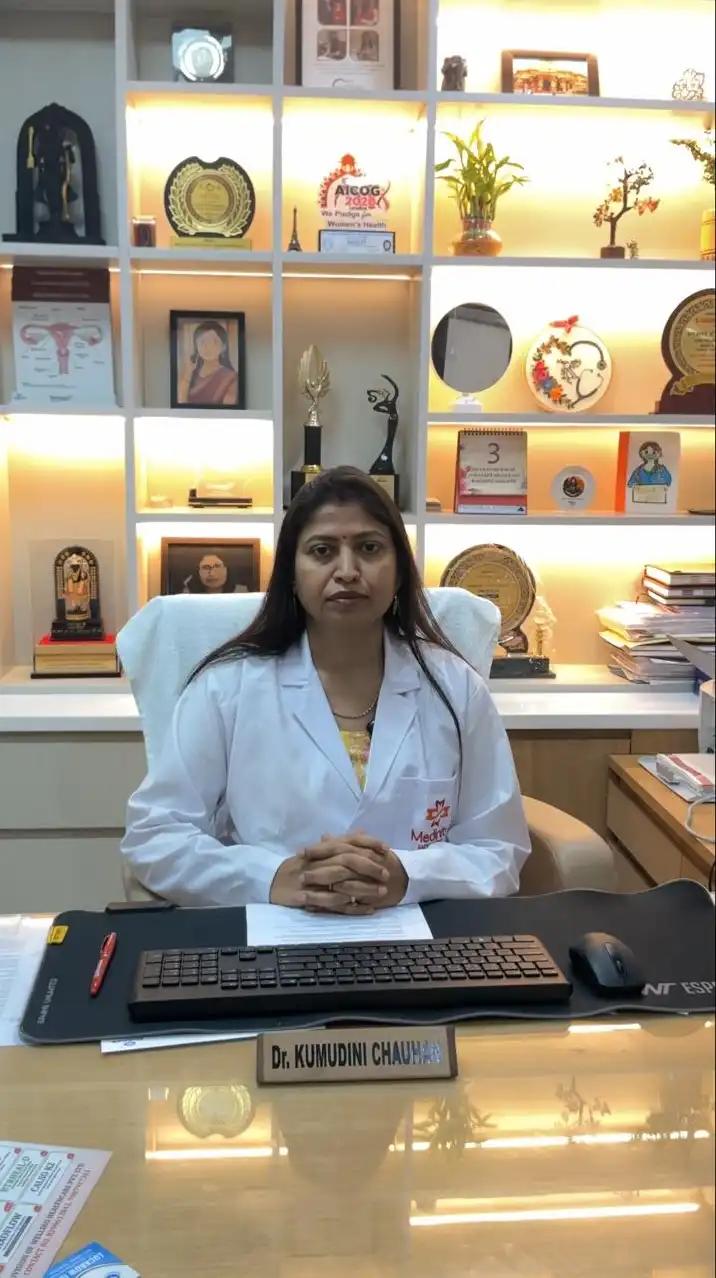
Dr. Chauhan is a senior gynaecologist and infertility specialist in Gomti Nagar, Lucknow with over 20 years of experience. She is dedicated to providing honest, evidence-based guidance to couples navigating fertility challenges.
Keep reading
Related articles

IUI Cost in Lucknow: What You Actually Pay (2026 Guide by Dr. Kumudini Chauhan)
IUI in Lucknow costs Rs 8,000 to Rs 18,000 per cycle. Dr. Kumudini Chauhan explains every component, what affects your total, and how it compares to IVF.

IVF Cost in Lucknow 2026: Full Transparent Breakdown by Dr. Kumudini Chauhan
IVF cost in Lucknow starts from Rs 1,10,000 per cycle at Ganga Laxmi IVF. Dr. Kumudini Chauhan explains every charge, what is included, and how to plan.
How to Increase AMH Levels: A Complete, Doctor Reviewed Guide
Can AMH levels really be increased? Learn what actually works, which foods and supplements may help, what science says, and when IVF is recommended. Doctor reviewed by fertility specialists at Ganga Laxmi IVF, Lucknow.
Blocked Fallopian Tube Treatment in Lucknow: Causes, HSG Test, IVF & Pregnancy Options
Blocked fallopian tubes are a leading cause of female infertility. Dr. Kumudini Chauhan explains causes, HSG testing and IVF options in Lucknow.