
In my clinic in Gomti Nagar, I meet at least two or three women every week who have just heard the words "your tubes are blocked" for the first time. It is a frightening phrase, mostly because nobody sits down and explains what it actually means. So let me explain it here the way I would in a consultation.
If you are searching for blocked fallopian tube treatment in Lucknow, the first thing to understand is that the diagnosis itself is not the full picture. What matters is where the blockage sits, how much of the tube is affected, and whether it actually needs surgery or IVF at all. Blocked fallopian tubes are one of the leading causes of female infertility, and in my own practice, roughly a third of the women I investigate for difficulty conceiving turn out to have some degree of tubal damage. If you have just been diagnosed, or if your doctor has raised it as a possibility, this article walks you through what a blockage means, how we confirm it, and what your treatment options actually look like here in Lucknow.
Key Fact
A blocked fallopian tube does not usually cause pain or any noticeable symptom. Most women only discover it while being investigated for infertility, sometimes years after the original damage occurred.
1. What Are Fallopian Tubes and Why They Matter for Fertility
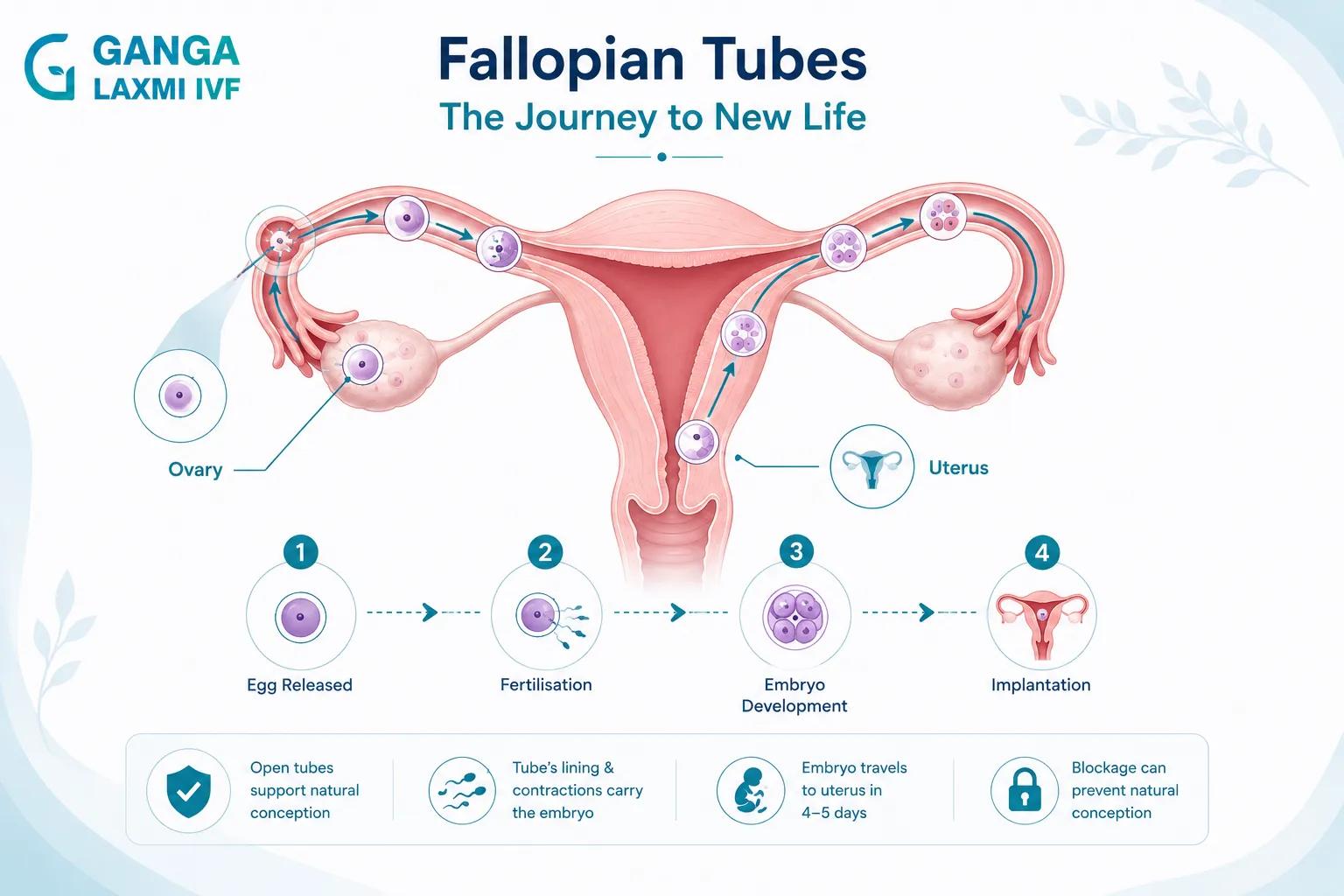
The fallopian tubes are two thin, muscular tubes that connect each ovary to the uterus. Every month, one ovary releases an egg, and the finger-like projections at the end of the nearby tube, called the fimbriae, sweep the egg inside.
Fertilisation itself happens inside the tube, not the uterus. Sperm travel up through the uterus into the tube to meet the egg, and if fertilisation occurs, the resulting embryo spends the next four to five days developing inside the tube before it moves into the uterus and implants. The tube's lining and its gentle muscular contractions are what carry the embryo along on this journey.
This is why a healthy, open tube matters so much. If the passage is blocked at any point, either the egg cannot be picked up, the sperm cannot reach the egg, or a fertilised embryo cannot travel onward to the uterus. Natural conception on that side becomes very unlikely.
2. What Causes Fallopian Tube Blockage
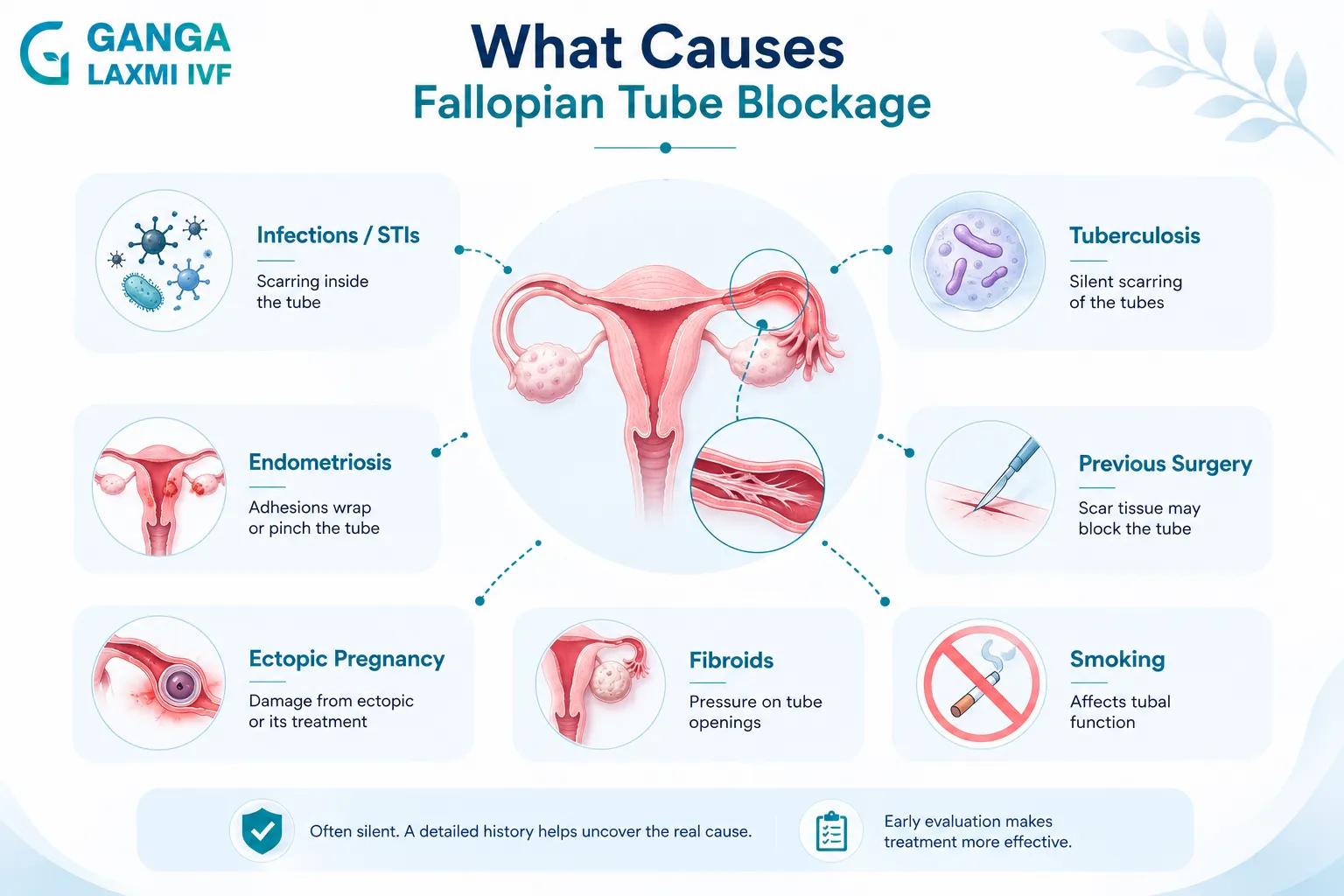
Nobody is born with a blocked tube. Tubal damage always has a cause, even if that cause went unnoticed at the time. The most common ones I see in my practice are listed below.
Pelvic infection or STIs (chlamydia, gonorrhoea)
How It Damages the Tube
Infection triggers inflammation and scarring inside the tube, which can seal it partly or completely.
Genital tuberculosis
How It Damages the Tube
A significant and under-recognised cause of tubal damage in India. It can scar the tubes without causing any obvious symptoms.
Endometriosis
How It Damages the Tube
Tissue and adhesions from endometriosis can wrap around or pinch the tube from outside.
Previous pelvic or abdominal surgery
How It Damages the Tube
Scar tissue formed during healing can trap or block a tube that was otherwise healthy.
Previous ectopic pregnancy
How It Damages the Tube
The affected tube is often damaged by the ectopic pregnancy itself or by the surgery used to treat it.
Fibroids
How It Damages the Tube
Depending on their position, fibroids can press on the opening of the tube where it meets the uterus.
Smoking (active and passive)
How It Damages the Tube
Smoking has been linked with impaired tubal function and is one of the modifiable risk factors I discuss with every patient.
| Cause | How It Damages the Tube |
|---|---|
| Pelvic infection or STIs (chlamydia, gonorrhoea) | Infection triggers inflammation and scarring inside the tube, which can seal it partly or completely. |
| Genital tuberculosis | A significant and under-recognised cause of tubal damage in India. It can scar the tubes without causing any obvious symptoms. |
| Endometriosis | Tissue and adhesions from endometriosis can wrap around or pinch the tube from outside. |
| Previous pelvic or abdominal surgery | Scar tissue formed during healing can trap or block a tube that was otherwise healthy. |
| Previous ectopic pregnancy | The affected tube is often damaged by the ectopic pregnancy itself or by the surgery used to treat it. |
| Fibroids | Depending on their position, fibroids can press on the opening of the tube where it meets the uterus. |
| Smoking (active and passive) | Smoking has been linked with impaired tubal function and is one of the modifiable risk factors I discuss with every patient. |
Because tubal damage is usually silent, you may have no memory of the infection, infertility episode or injury that caused it. This is exactly why a detailed history is the first step in any fertility evaluation, not just a scan or a blood test.
3. Types of Fallopian Tube Blockage
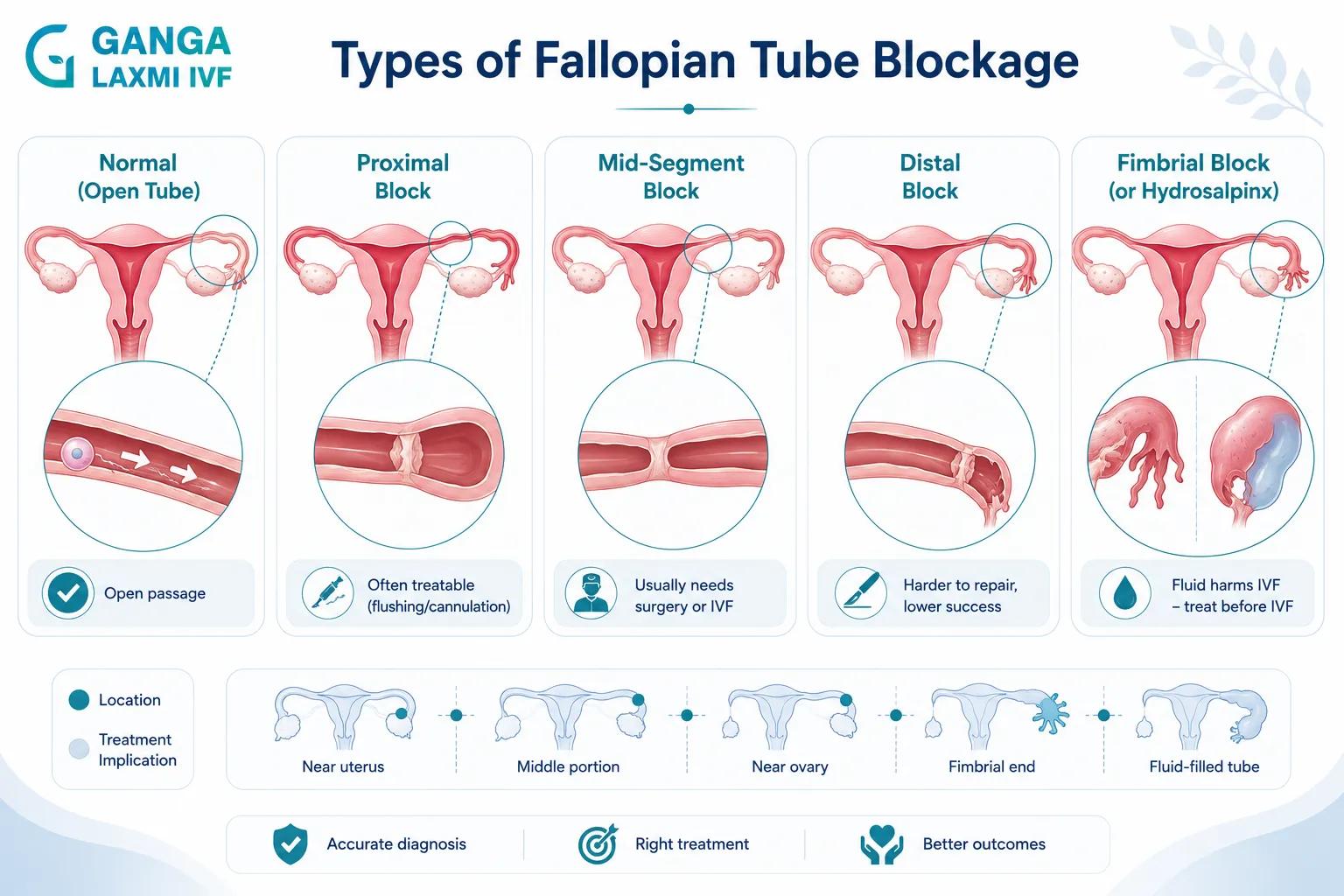
Where the blockage sits along the tube changes both how it is found and how it can be treated. This is one of the first things I assess after a positive test.
Proximal block
Location
Near the point where the tube meets the uterus
What It Means for Treatment
Often the most treatable type. Can sometimes be cleared with tubal flushing or tubal cannulation, without surgery.
Mid-segment block
Location
Middle portion of the tube
What It Means for Treatment
Less common. Usually needs surgical assessment or is best bypassed with IVF.
Distal block
Location
Far end of the tube, near the ovary
What It Means for Treatment
Harder to repair surgically, and success rates for reconstructive surgery here are modest.
Fimbrial block
Location
The finger-like projections at the tube's end
What It Means for Treatment
Reduces the tube's ability to pick up the released egg, even if the rest of the tube is open.
Hydrosalpinx
Location
Usually a distal blockage with fluid trapped inside
What It Means for Treatment
The trapped fluid can leak back into the uterus and lower IVF success significantly. It usually needs to be addressed before starting IVF.
| Type | Location | What It Means for Treatment |
|---|---|---|
| Proximal block | Near the point where the tube meets the uterus | Often the most treatable type. Can sometimes be cleared with tubal flushing or tubal cannulation, without surgery. |
| Mid-segment block | Middle portion of the tube | Less common. Usually needs surgical assessment or is best bypassed with IVF. |
| Distal block | Far end of the tube, near the ovary | Harder to repair surgically, and success rates for reconstructive surgery here are modest. |
| Fimbrial block | The finger-like projections at the tube's end | Reduces the tube's ability to pick up the released egg, even if the rest of the tube is open. |
| Hydrosalpinx | Usually a distal blockage with fluid trapped inside | The trapped fluid can leak back into the uterus and lower IVF success significantly. It usually needs to be addressed before starting IVF. |
4. Do Blocked Fallopian Tubes Cause Symptoms
Almost never on their own. The blockage itself is usually painless, which is precisely why so many women only find out about it while being investigated for infertility. That said, you may notice symptoms related to whatever caused the damage in the first place.
- Pelvic pain or painful periods, often linked to endometriosis
- A history of pelvic inflammatory disease, a sexually transmitted infection, or an unusually painful episode after childbirth or a procedure
- Watery or unusual vaginal discharge, occasionally seen with a hydrosalpinx
- Difficulty conceiving after 6 to 12 months of trying, which is often the first sign for most women
5. How Is Tubal Blockage Diagnosed
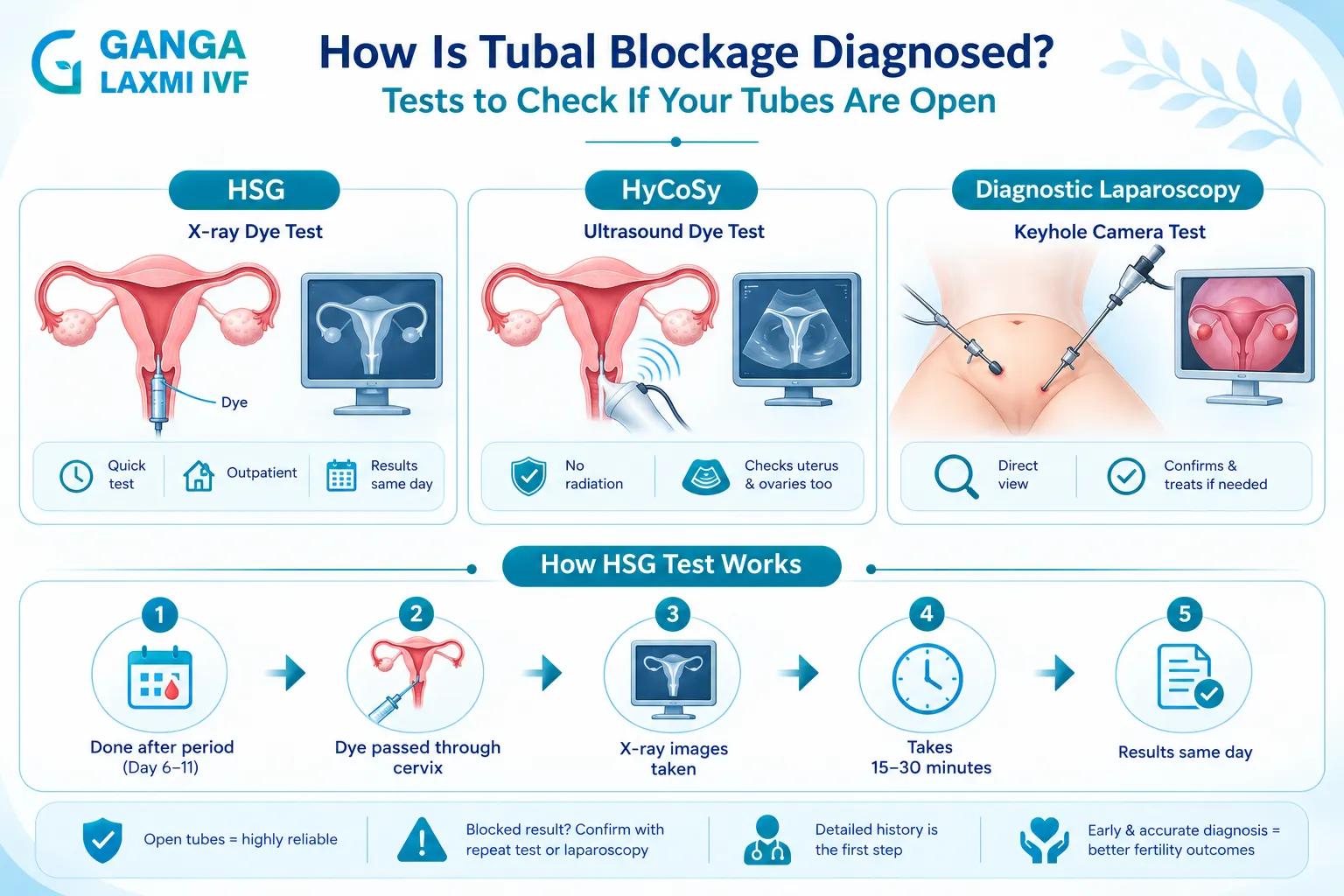
The first step is always a detailed history, not a scan. If you have no risk factors at all, no past infection, no endometriosis, no prior surgery or ectopic pregnancy, then the likelihood of a tubal blockage is low, and it may be reasonable to keep trying naturally for a while before testing. If you do have risk factors, or you have not conceived within 6 to 12 months, tube testing is the logical next step.
HSG
Full Name
Hysterosalpingography
How It Works
Dye is injected through the cervix and an X-ray shows whether it spills freely from both tubes.
Best Suited For
First-line test for most women. Quick, outpatient, results the same day.
HyCoSy
Full Name
Hysterosalpingo Contrast Sonography
How It Works
Similar dye test, but tracked on ultrasound instead of X-ray.
Best Suited For
Women who want to avoid radiation exposure, or want the uterus and ovaries checked in the same sitting.
Diagnostic Laparoscopy
Full Name
Direct visual examination
How It Works
A camera is passed through a small incision to view the tubes, ovaries and pelvis directly, and dye can be tested through the tube at the same time.
Best Suited For
Women with symptoms of endometriosis, or when an HSG result needs confirmation.
| Test | Full Name | How It Works | Best Suited For |
|---|---|---|---|
| HSG | Hysterosalpingography | Dye is injected through the cervix and an X-ray shows whether it spills freely from both tubes. | First-line test for most women. Quick, outpatient, results the same day. |
| HyCoSy | Hysterosalpingo Contrast Sonography | Similar dye test, but tracked on ultrasound instead of X-ray. | Women who want to avoid radiation exposure, or want the uterus and ovaries checked in the same sitting. |
| Diagnostic Laparoscopy | Direct visual examination | A camera is passed through a small incision to view the tubes, ovaries and pelvis directly, and dye can be tested through the tube at the same time. | Women with symptoms of endometriosis, or when an HSG result needs confirmation. |
What to Expect During an HSG Test
- Timing: performed after your period has ended and before ovulation, usually between day 6 and day 11 of your cycle
- During the test: a thin catheter is passed through the cervix and a contrast dye is injected while X-ray images are taken, the whole test takes 15 to 30 minutes
- Sensation: mild period-like cramping during and shortly after the procedure is common and normal
- Results: available the same day, and Dr. Chauhan reviews them with you directly rather than leaving you to interpret a report alone
- After the test: light spotting for a day or two is normal, avoid unprotected intercourse until your doctor confirms it is safe to try again
Important clinical note
An HSG that shows an open tube is highly reliable. An HSG that shows a blocked tube is less reliable on its own; a meaningful proportion of women initially diagnosed with a blockage turn out to have a normal tube once retested or checked by laparoscopy. I always recommend confirming a blocked result before it drives a major treatment decision such as surgery.
The exact cost of an HSG test at Ganga Laxmi IVF is confirmed clearly during your consultation, along with a full breakdown of what it covers. There are no hidden charges.
6. Can Blocked Fallopian Tubes Be Treated
This depends almost entirely on where the blockage sits and how much of the tube is affected. There is no single answer that applies to every woman, which is why I avoid giving a generic recommendation before I have seen your specific test results.
One tube blocked, the other open and functioning normally
Usual Approach
Natural conception or IUI. Evidence shows women with one healthy tube have similar chances of conceiving as women with two open tubes.
Mild proximal blockage
Usual Approach
Tubal flushing during the HSG itself, or tubal cannulation, both done without surgery.
Blockage with symptoms of endometriosis
Usual Approach
Laparoscopy, which allows Dr. Chauhan to treat the endometriosis and assess the tube in the same procedure.
Severe or complete bilateral blockage
Usual Approach
Reconstructive surgery such as tuboplasty or salpingostomy (reopening the tube) can be attempted in select cases, but IVF is generally preferred, since surgical success rates are modest and the risk of ectopic pregnancy rises after tubal surgery.
Hydrosalpinx identified before IVF
Usual Approach
The affected tube is usually removed (salpingectomy) or disconnected by laparoscopy before starting IVF, an established part of assisted reproductive technology (ART) protocols, to protect the chances of success.
| Your Situation | Usual Approach |
|---|---|
| One tube blocked, the other open and functioning normally | Natural conception or IUI. Evidence shows women with one healthy tube have similar chances of conceiving as women with two open tubes. |
| Mild proximal blockage | Tubal flushing during the HSG itself, or tubal cannulation, both done without surgery. |
| Blockage with symptoms of endometriosis | Laparoscopy, which allows Dr. Chauhan to treat the endometriosis and assess the tube in the same procedure. |
| Severe or complete bilateral blockage | Reconstructive surgery such as tuboplasty or salpingostomy (reopening the tube) can be attempted in select cases, but IVF is generally preferred, since surgical success rates are modest and the risk of ectopic pregnancy rises after tubal surgery. |
| Hydrosalpinx identified before IVF | The affected tube is usually removed (salpingectomy) or disconnected by laparoscopy before starting IVF, an established part of assisted reproductive technology (ART) protocols, to protect the chances of success. |
Why hydrosalpinx needs special attention
A hydrosalpinx is not just a blocked tube, it is a blocked tube filled with fluid, and that fluid matters. Research consistently shows that fluid from a hydrosalpinx can leak back into the uterus and lower IVF success considerably, in some studies by around half. This is thought to happen because the fluid can be toxic to a developing embryo and can physically disturb the uterine lining right when an embryo is trying to implant. Multiple clinical trials have shown that removing or blocking the affected tube before an IVF cycle restores success rates close to normal. If a hydrosalpinx is found on your scan, addressing it first is not an extra step, it is often the step that makes IVF work.
7. IVF as the Most Effective Treatment for Tubal Blockage
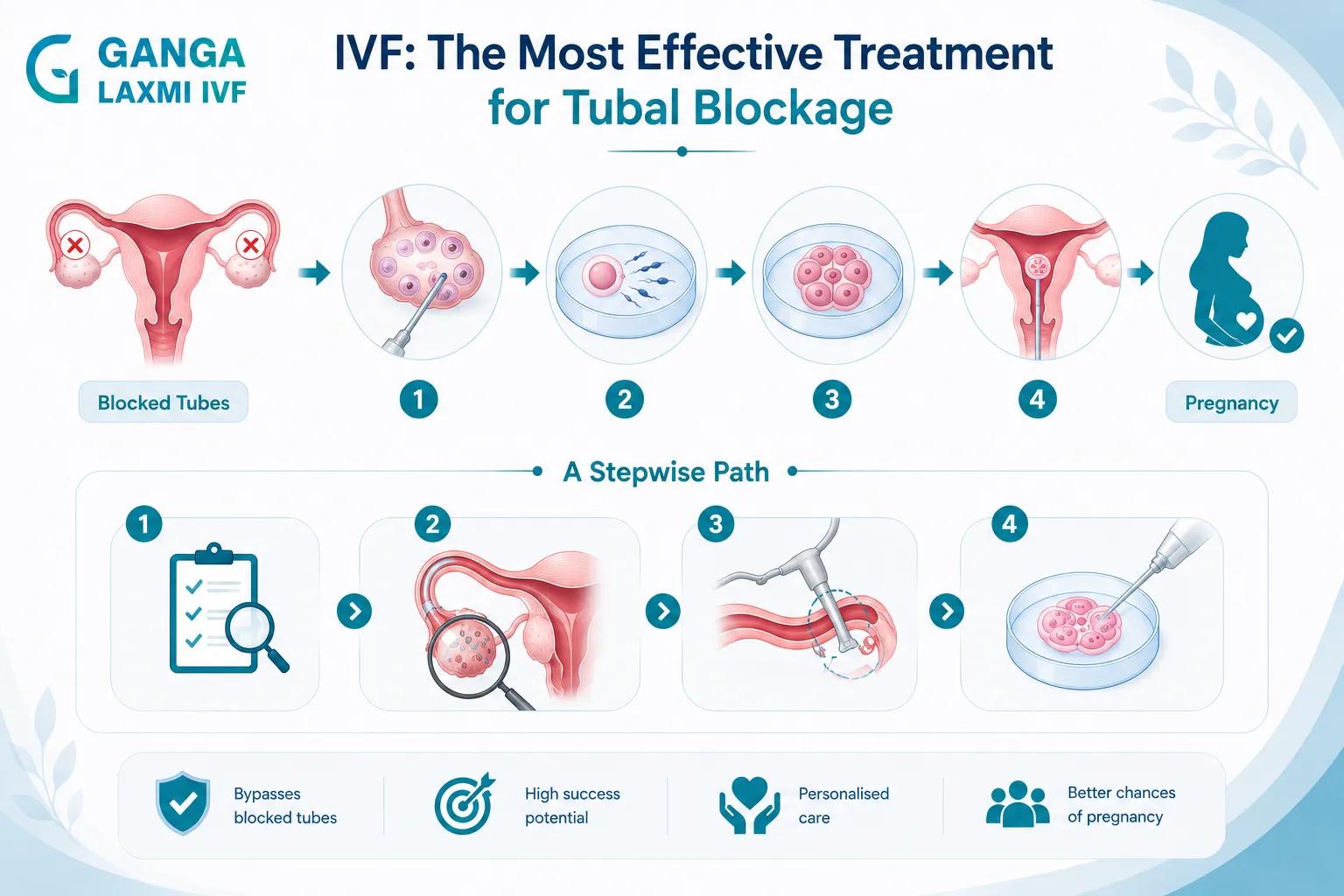
IVF is considered the first-line treatment for complete or severe tubal blockage because it removes the tube from the equation entirely. Eggs are retrieved directly from the ovary, fertilised in the laboratory, and the resulting embryo is placed directly into the uterus. The journey the tube would normally manage is done for it.
Once any hydrosalpinx has been addressed, success rates for IVF in tubal factor infertility are broadly comparable to IVF performed for other causes of infertility. Dr. Chauhan will assess whether one or both tubes are affected, whether hydrosalpinx is present, and whether any other fertility factors, such as ovarian reserve or sperm parameters, are also at play before recommending your treatment path.
A Stepwise Path, Not a Single Decision
- 1. Confirm the diagnosis: If a blockage is found on HSG, Dr. Chauhan often recommends confirming it with a repeat test or laparoscopy before deciding on treatment.
- 2. Assess whether surgery is appropriate: Based on the location and extent of the blockage, and whether the rest of the tube looks healthy.
- 3. Treat hydrosalpinx if present: Laparoscopic removal or disconnection of the affected tube, done before IVF begins, not during it.
- 4. Proceed with IVF where indicated: Eggs are retrieved directly and embryos are transferred to the uterus, bypassing the tubes completely.
8. Comparing Your Treatment Options
It helps to see the main options side by side. This is a general guide, your actual recommendation depends on your specific test results and history.
Tubal flushing or cannulation
Best For
Mild, proximal blockage only
Pregnancy Chance
A meaningful number of women conceive naturally within 3 to 6 months afterward
Recovery
Same day, no downtime
Laparoscopic surgery (tuboplasty or salpingostomy)
Best For
Minimal damage, healthy surrounding tube
Pregnancy Chance
Varies widely by severity, and declines with more extensive damage
Recovery
Few days to a week
Salpingectomy for hydrosalpinx
Best For
Fluid-filled, badly damaged tube before IVF
Pregnancy Chance
Restores IVF chances closer to normal, rather than achieving pregnancy on its own
Recovery
About a week
IVF
Best For
Severe or complete bilateral blockage, or after failed surgery
Pregnancy Chance
Comparable to IVF for other causes of infertility, and driven mainly by the woman's age
Recovery
Embryo transfer itself has no downtime, the full cycle takes 4 to 6 weeks
| Treatment | Best For | Pregnancy Chance | Recovery |
|---|---|---|---|
| Tubal flushing or cannulation | Mild, proximal blockage only | A meaningful number of women conceive naturally within 3 to 6 months afterward | Same day, no downtime |
| Laparoscopic surgery (tuboplasty or salpingostomy) | Minimal damage, healthy surrounding tube | Varies widely by severity, and declines with more extensive damage | Few days to a week |
| Salpingectomy for hydrosalpinx | Fluid-filled, badly damaged tube before IVF | Restores IVF chances closer to normal, rather than achieving pregnancy on its own | About a week |
| IVF | Severe or complete bilateral blockage, or after failed surgery | Comparable to IVF for other causes of infertility, and driven mainly by the woman's age | Embryo transfer itself has no downtime, the full cycle takes 4 to 6 weeks |
9. What Are the Chances of Pregnancy After Blocked Tube Treatment
This is usually the first question in every consultation, and it deserves an honest, unhurried answer rather than a single number.
- One tube blocked, one tube open: chances of natural conception are similar to women with two healthy tubes, provided ovulation and semen parameters are normal.
- Both tubes blocked, mild and proximal: reasonable chance of natural conception after tubal flushing or cannulation, usually within 3 to 6 months.
- Both tubes blocked, treated surgically: outcomes vary widely depending on how much healthy tube remains, this is why Dr. Chauhan is selective about who is offered surgery at all.
- Both tubes blocked or removed, proceeding to IVF: success is comparable to IVF performed for any other cause of infertility, and age is by far the biggest factor; younger women consistently see meaningfully higher success rates per cycle than women in their late 30s and 40s.
- Hydrosalpinx left untreated before IVF: success can drop substantially, which is exactly why it is addressed before the cycle begins rather than left alone.
The honest answer
Your age and ovarian reserve influence your chances of pregnancy at least as much as the tubal blockage itself. Two women with an identical HSG report can have very different outlooks depending on age, egg count and how long they have been trying. Dr. Chauhan gives every patient a personalised estimate after reviewing the complete picture, not a generic percentage copied from a website.
10. How Long Does Blocked Tube Treatment Take
Every case moves at its own pace, but most patients follow a similar sequence from first visit to treatment.
- Consultation and history review, first visit
- HSG or HyCoSy testing, usually within the same cycle
- Diagnosis confirmed, occasionally with a repeat test or laparoscopy
- Treatment decided, ranging from tubal flushing to laparoscopy to IVF
- Trying naturally or IUI, where appropriate, for a defined trial period
- IVF, where indicated, typically a 4 to 6 week cycle from stimulation to embryo transfer
11. Cost of Blocked Fallopian Tube Treatment in Lucknow
Cost is one of the most common questions I get, and also one of the hardest to answer with a single figure, because it genuinely depends on what your case needs.
- HSG test: a diagnostic, outpatient procedure, priced separately from treatment.
- Laparoscopy: cost depends on whether it is purely diagnostic or includes treatment such as adhesiolysis, tuboplasty or salpingectomy.
- IVF: cost depends on your stimulation protocol, the number of eggs retrieved, and whether additional steps such as ICSI or hydrosalpinx surgery are required beforehand.
- Medication costs: vary by protocol and by how your ovaries respond to stimulation, and are billed separately from clinic fees.
Rather than quoting a number that will not apply to your specific case, Dr. Chauhan provides a complete, itemised estimate at your consultation once your test results and treatment plan are known. There are no hidden charges.
12. When Should You See a Fertility Specialist
You do not need to wait for a diagnosis to walk through the door. Consider booking a consultation if any of the following apply to you.
13. Myths vs Facts About Blocked Fallopian Tubes
Blocked tubes always need IVF
Fact
False. Mild, proximal blockages can sometimes be treated with tubal flushing or cannulation, without surgery or IVF.
One blocked tube means you cannot get pregnant
Fact
False. If the other tube is healthy and open, your chances of natural conception are largely unaffected.
The HSG test is unbearable
Fact
False. Most women describe it as similar to period cramps, and it settles within a few hours.
Tubes can be unblocked with medicines alone
Fact
False. There is no medication that reliably clears a blocked fallopian tube. Treatment requires a physical procedure, whether that is flushing, cannulation, surgery or IVF.
A blocked tube always causes pain
Fact
False. Tubal blockage is usually completely silent and is often discovered only during a fertility workup.
| Myth | Fact |
|---|---|
| Blocked tubes always need IVF | False. Mild, proximal blockages can sometimes be treated with tubal flushing or cannulation, without surgery or IVF. |
| One blocked tube means you cannot get pregnant | False. If the other tube is healthy and open, your chances of natural conception are largely unaffected. |
| The HSG test is unbearable | False. Most women describe it as similar to period cramps, and it settles within a few hours. |
| Tubes can be unblocked with medicines alone | False. There is no medication that reliably clears a blocked fallopian tube. Treatment requires a physical procedure, whether that is flushing, cannulation, surgery or IVF. |
| A blocked tube always causes pain | False. Tubal blockage is usually completely silent and is often discovered only during a fertility workup. |
Many patients travel to our Gomti Nagar clinic from across Lucknow, including Hazratganj, Indira Nagar, Aliganj, Jankipuram, Faizabad Road, Sitapur Road, Rae Bareli Road and Kanpur Road, for tubal blockage evaluation and treatment.
14. Tubal Blockage Care at Ganga Laxmi IVF, Lucknow
Every woman who comes to me with a tubal factor diagnosis has a different history and a different level of anxiety about what it means for her. My approach is to confirm the diagnosis properly, explain the options honestly, and recommend only what is actually needed.
Confirm before treating
What It Means for You
A single HSG showing a blockage is not treated as final. Dr. Chauhan repeats testing or uses laparoscopy where appropriate, so you are not rushed into unnecessary surgery.
Individualised treatment planning
What It Means for You
Not every woman with a tubal factor diagnosis needs IVF immediately. Where flushing, cannulation or laparoscopy is appropriate, that is discussed first.
Hydrosalpinx managed before IVF
What It Means for You
Where hydrosalpinx is present, it is addressed surgically before the IVF cycle begins, to protect your chances of success.
Experienced embryology and IVF team
What It Means for You
Your IVF cycle, from stimulation to embryo transfer, is managed in house without the need for external referrals.
Transparent cost discussion
What It Means for You
Testing and treatment costs are explained clearly at consultation, with no hidden charges.
| What We Do | What It Means for You |
|---|---|
| Confirm before treating | A single HSG showing a blockage is not treated as final. Dr. Chauhan repeats testing or uses laparoscopy where appropriate, so you are not rushed into unnecessary surgery. |
| Individualised treatment planning | Not every woman with a tubal factor diagnosis needs IVF immediately. Where flushing, cannulation or laparoscopy is appropriate, that is discussed first. |
| Hydrosalpinx managed before IVF | Where hydrosalpinx is present, it is addressed surgically before the IVF cycle begins, to protect your chances of success. |
| Experienced embryology and IVF team | Your IVF cycle, from stimulation to embryo transfer, is managed in house without the need for external referrals. |
| Transparent cost discussion | Testing and treatment costs are explained clearly at consultation, with no hidden charges. |
Confidential consultation
Every consultation regarding fertility investigations at Ganga Laxmi IVF is completely confidential. If you have recently received a tubal blockage diagnosis and are unsure what it means for you, a clear conversation about your specific report is often the most useful first step.
15. Frequently Asked Questions
These are the questions I am asked most often about blocked fallopian tubes. I have answered each one the way I would in a consultation.
Often, yes. If your other tube is open and functioning, and ovulation occurs from that side, natural conception remains possible, and evidence suggests the chances are similar to women with two healthy tubes. However, the risk of ectopic pregnancy is somewhat higher, so Dr. Chauhan will advise monitoring closely once you conceive.
The exact cost is confirmed clearly during your consultation, along with what the test covers. Results are available the same day, and there are no hidden charges.
No. For mild or proximal blockages, tubal flushing or cannulation may clear the passage without surgery. For blockages linked to endometriosis, laparoscopy can treat both issues together. IVF becomes the recommended option mainly when both tubes are severely blocked or damaged beyond repair.
Usually not. Most women with blocked fallopian tubes have no symptoms at all until they experience difficulty conceiving. Any pain you notice is more likely linked to the underlying cause, such as endometriosis or a past infection, rather than the blockage itself.
Sometimes. If the blockage is mild and close to the uterus, it can occasionally be cleared through tubal flushing performed during an HSG, or through tubal cannulation, a guided wire procedure done at the same time. This is only suitable for proximal, mild blockages.
Yes, through IVF. IVF does not require functioning fallopian tubes at all, since fertilisation happens outside the body and the embryo is placed directly into the uterus.
In most cases, yes. Fluid trapped in a hydrosalpinx can leak into the uterus and significantly lower IVF success. Removing or disconnecting the affected tube beforehand, usually by laparoscopy, is a well-established step that improves the chances of a successful IVF cycle.
Most women describe it as similar to period cramps, and it typically settles within a few hours. The test itself takes 15 to 30 minutes, and you can usually resume normal activity the same day.
A Blocked Tube Is a Starting Point, Not a Verdict
A blocked fallopian tube diagnosis can feel like the end of a natural path to pregnancy. In most cases, it is simply the point where the path changes, not where it ends. Whether your case needs a simple flushing procedure, laparoscopic surgery, or IVF, there is a route forward, and it starts with confirming exactly what you are dealing with.
Book a confidential consultation
Not sure whether your tubes are truly blocked? Bring your HSG report to Dr. Kumudini Chauhan for a detailed review. Many women are relieved to discover that an apparent blockage may not require surgery or IVF at all.
About the author
Dr. Kumudini Chauhan
Dr. Kumudini Chauhan
IVF & fertility
Dr. Chauhan is a senior gynaecologist and infertility specialist in Gomti Nagar, Lucknow with over 20 years of experience. She is dedicated to providing honest, evidence-based guidance to couples navigating fertility challenges.
Keep reading
Related articles

Azoospermia (Zero Sperm Count) Treatment in Lucknow
Diagnosed with zero sperm count? Dr. Kumudini Chauhan explains azoospermia causes and male infertility treatment with TESA, PESA, MicroTESE and ICSI in Lucknow.

Black Period Blood: Causes, Symptoms, Treatment and When to See a Doctor
Black period blood is usually harmless old blood, but it can signal PCOS, low estrogen or an infection. Know the causes, warning signs & when to consult a gynaecologist in Lucknow.

Kangaroo Mother Care (KMC): A Simple Yet Powerful Way to Save Newborn Lives
What is Kangaroo Mother Care? Learn how skin-to-skin contact saves premature babies, improves breastfeeding, and supports growth. A complete KMC guide.

IVF After a Failed Cycle: What to Do Next, and Why It Still Works
A failed IVF cycle does not mean the end. Dr. Kumudini Chauhan, Lucknow, explains what causes failure, what changes for the next cycle, and why many patients succeed after one setback.