
Being told that your semen has no sperm in it is one of the hardest sentences a man can hear from a doctor. Most men who hear it walk out of the appointment believing the door to biological fatherhood has closed for good. In my clinic in Gomti Nagar, I meet that assumption almost every week, and almost every week I get to correct it.
A zero sperm count, which doctors call azoospermia, does not automatically mean zero sperm in the body. With the right diagnosis and the right retrieval technique, a meaningful number of men with azoospermia go on to father their own biological children.
Quick facts on azoospermia
- Azoospermia affects close to 1 percent of all men in the general population.
- It is found in around 10 to 15 percent of men evaluated for infertility.
- Obstructive azoospermia, a blockage rather than a production problem, accounts for roughly 40 percent of cases, and usually has the best retrieval odds.
- Even in non-obstructive azoospermia, sperm can be found in a meaningful proportion of men when a microsurgical retrieval technique is used.
1. What Does Zero Sperm Count Mean?
Quick Answer
A zero sperm count means no sperm were seen in your ejaculated semen on laboratory testing. Doctors call this azoospermia. It does not mean your body has stopped making sperm altogether. In many men, sperm are still being produced but cannot reach the semen, or production is reduced rather than completely absent. The type and cause decide what treatment is possible.
A zero sperm count is confirmed only after the semen sample has been centrifuged, spun down so any sperm present settle out and become visible, and checked again under the microscope. A single low reading is not enough for a diagnosis, since collection issues, illness, or a short abstinence period can all produce a falsely low result. Most specialists, including our team, ask for two separate semen analyses a few weeks apart before treating this as a confirmed diagnosis.
2. The Two Types of Azoospermia: Obstructive vs Non-Obstructive
Quick Answer
Obstructive azoospermia means sperm are being made normally but a physical blockage stops them from reaching the semen. Non-obstructive azoospermia means the testicles themselves are producing very little or no sperm. This distinction, more than the diagnosis itself, decides your treatment plan and your outlook.
Obstructive Azoospermia (OA)
What Is Happening
Sperm production is normal, but a physical blockage stops sperm from reaching the semen
Common Causes
Prior vasectomy, congenital absence of the vas deferens (CBAVD), past infection such as epididymitis or genital TB, injury or surgery in the groin, a blocked ejaculatory duct
General Outlook
Very good. Sperm retrieval succeeds in nearly all cases, since the testicle itself is producing normally
Non-Obstructive Azoospermia (NOA)
What Is Happening
The testicles are producing very little or no sperm
Common Causes
Hormonal imbalance (low FSH or LH), varicocele, Klinefelter syndrome, Y-chromosome microdeletion, an undescended testicle in childhood, past chemotherapy or radiotherapy, mumps orchitis
General Outlook
Depends on the cause. Retrieval succeeds in roughly 40 to 60 percent of cases with MicroTESE, and is higher when a reversible cause such as a hormone deficiency or varicocele is treated first
| Type | What Is Happening | Common Causes | General Outlook |
|---|---|---|---|
| Obstructive Azoospermia (OA) | Sperm production is normal, but a physical blockage stops sperm from reaching the semen | Prior vasectomy, congenital absence of the vas deferens (CBAVD), past infection such as epididymitis or genital TB, injury or surgery in the groin, a blocked ejaculatory duct | Very good. Sperm retrieval succeeds in nearly all cases, since the testicle itself is producing normally |
| Non-Obstructive Azoospermia (NOA) | The testicles are producing very little or no sperm | Hormonal imbalance (low FSH or LH), varicocele, Klinefelter syndrome, Y-chromosome microdeletion, an undescended testicle in childhood, past chemotherapy or radiotherapy, mumps orchitis | Depends on the cause. Retrieval succeeds in roughly 40 to 60 percent of cases with MicroTESE, and is higher when a reversible cause such as a hormone deficiency or varicocele is treated first |
%20vs%20Non-Obstructive%20Azoospermia%20(production%20issue)..webp&w=3840&q=75)
3. Can You Get Pregnant With Zero Sperm Count?
Quick Answer
Yes, pregnancy is possible for many couples even when the male partner has a zero sperm count. The path depends on the type of azoospermia: some men achieve natural conception after reconstructive surgery, while others need a surgical sperm retrieval procedure such as TESA, PESA or MicroTESE combined with ICSI, where a single retrieved sperm is injected directly into an egg.
- Obstructive azoospermia generally carries an excellent outlook. Sperm retrieval succeeds in nearly all cases, and in some men reconstructive surgery can restore natural conception entirely.
- Non-obstructive azoospermia caused by a hormonal deficiency (hypogonadotropic hypogonadism) can sometimes be reversed with hormone injections over four to six months, after which sperm may reappear in the semen on its own.
- Non-obstructive azoospermia linked to a varicocele can improve after surgical repair, with some men regaining measurable sperm counts within six to nine months.
- Non-obstructive azoospermia with no reversible cause found still has real options. MicroTESE can locate isolated pockets of sperm production inside testicular tissue that a standard biopsy would miss, and even a small number of retrieved sperm is enough for ICSI.
- If no sperm are found even after a thorough surgical search, donor sperm remains an option, and it is one we discuss with complete confidentiality and without judgement.
Dr. Kumudini Chauhan says
"Many men assume that a zero sperm count means they can never have biological children. In reality, a large number of my patients with azoospermia still have retrievable sperm, depending on the underlying cause. The diagnosis is a starting point for investigation, not a final answer."
4. Can Zero Sperm Count Be Treated Naturally?
Quick Answer
Lifestyle changes alone cannot reverse a physical blockage or most genetic causes of azoospermia. They can help in specific, reversible situations, such as when a hormonal imbalance is linked to obesity, or when heat exposure, certain medications, or heavy alcohol and tobacco use are contributing factors. For most men with a confirmed zero sperm count, medical or surgical treatment is required alongside any lifestyle changes.
I understand why this question comes up so often. Searching for a natural fix feels like a safer first step than surgery, and for a low but present sperm count, some lifestyle changes genuinely do help. But azoospermia is a different situation. If the cause is a blockage, no amount of diet or exercise change will open it. If the cause is a chromosomal condition such as Klinefelter syndrome, it cannot be reversed through lifestyle alone.
Where lifestyle factors do play a real, evidence-supported role is in specific non-obstructive cases: correcting obesity-related hormonal imbalance, treating a varicocele, managing thyroid dysfunction, stopping anabolic steroid use, and reducing prolonged heat exposure to the testicles from things like frequent hot tub use or certain occupations. A general, well-balanced diet with adequate zinc and folate supports overall reproductive health, but it is a supporting measure, not a substitute for a proper diagnosis. I would rather tell you honestly whether lifestyle change is likely to help in your specific case than let you spend months hoping it will when it will not.
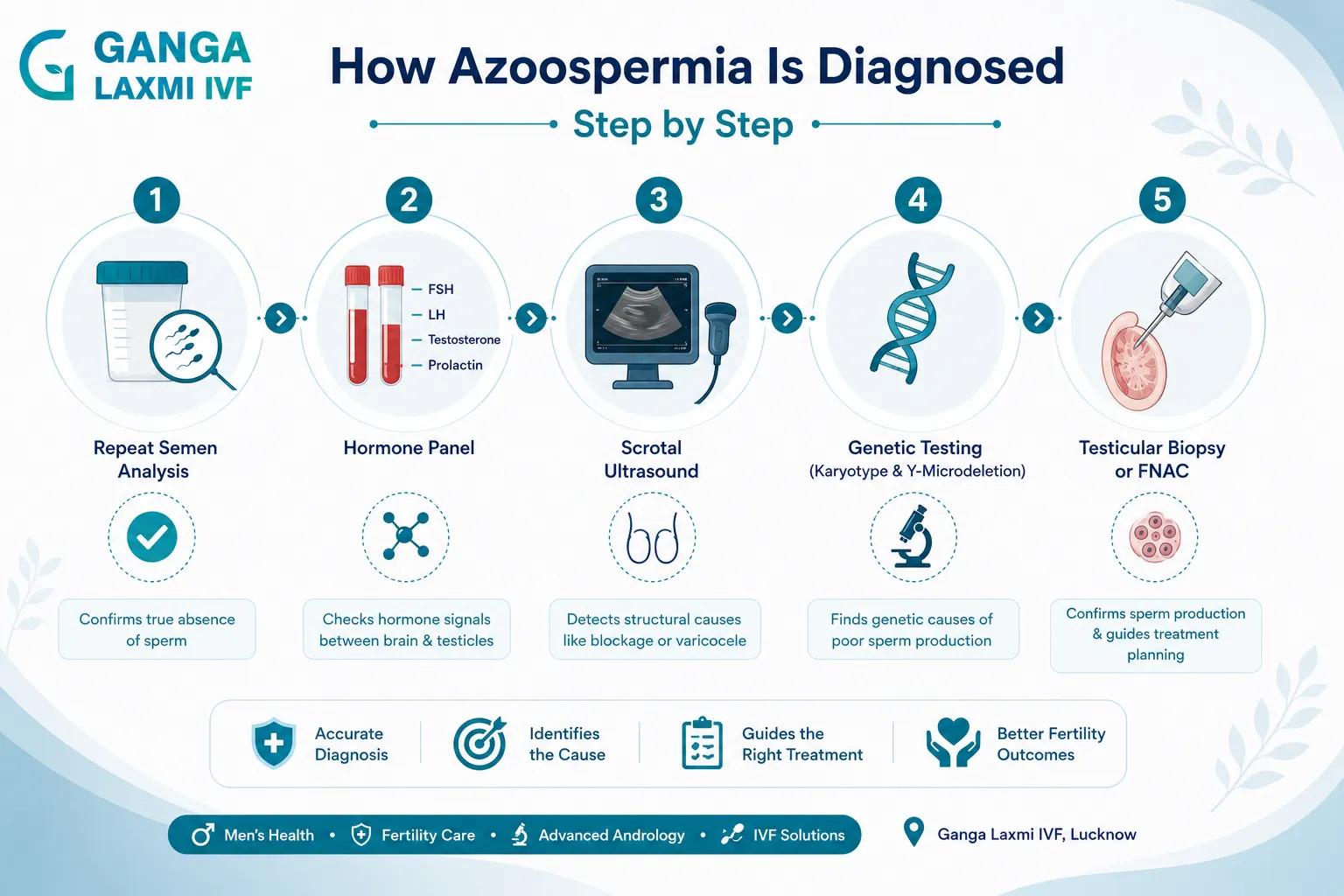
5. How Azoospermia Is Diagnosed, Step by Step
A proper workup takes a little time, but it is what separates a guess from a plan. Here is the sequence I follow with every patient.
Repeat semen analysis (centrifuged)
What It Checks
Confirms a true absence of sperm rather than a very low count that was missed on a routine slide
Why It Matters
One low reading is never a diagnosis on its own. This step rules out a lab or collection error before anything else happens
Hormone panel: FSH, LH, testosterone, prolactin
What It Checks
Whether the signalling between the brain and the testicles is working normally
Why It Matters
A high FSH usually points to a testicular production problem. A low FSH and LH often points to a treatable pituitary or hypothalamic cause
Scrotal ultrasound
What It Checks
Structure of the testicle and epididymis, presence of a varicocele, or absence of the vas deferens
Why It Matters
Identifies physical and structural causes of blockage that a physical exam alone can miss
Karyotyping and Y-chromosome microdeletion test
What It Checks
Genetic causes behind poor sperm production
Why It Matters
Recommended before any surgical retrieval in non-obstructive cases. Some genetic findings change the treatment plan and matter for the health of a future child
Testicular biopsy or FNAC
What It Checks
Whether sperm production is actually happening inside the testicular tissue
Why It Matters
Confirms the diagnosis and helps predict the likelihood of a successful retrieval. It is often combined directly with the retrieval procedure itself to avoid a second surgery
| Test | What It Checks | Why It Matters |
|---|---|---|
| Repeat semen analysis (centrifuged) | Confirms a true absence of sperm rather than a very low count that was missed on a routine slide | One low reading is never a diagnosis on its own. This step rules out a lab or collection error before anything else happens |
| Hormone panel: FSH, LH, testosterone, prolactin | Whether the signalling between the brain and the testicles is working normally | A high FSH usually points to a testicular production problem. A low FSH and LH often points to a treatable pituitary or hypothalamic cause |
| Scrotal ultrasound | Structure of the testicle and epididymis, presence of a varicocele, or absence of the vas deferens | Identifies physical and structural causes of blockage that a physical exam alone can miss |
| Karyotyping and Y-chromosome microdeletion test | Genetic causes behind poor sperm production | Recommended before any surgical retrieval in non-obstructive cases. Some genetic findings change the treatment plan and matter for the health of a future child |
| Testicular biopsy or FNAC | Whether sperm production is actually happening inside the testicular tissue | Confirms the diagnosis and helps predict the likelihood of a successful retrieval. It is often combined directly with the retrieval procedure itself to avoid a second surgery |
6. Sperm Retrieval Procedures: TESA, PESA and MicroTESE Explained
Quick Answer
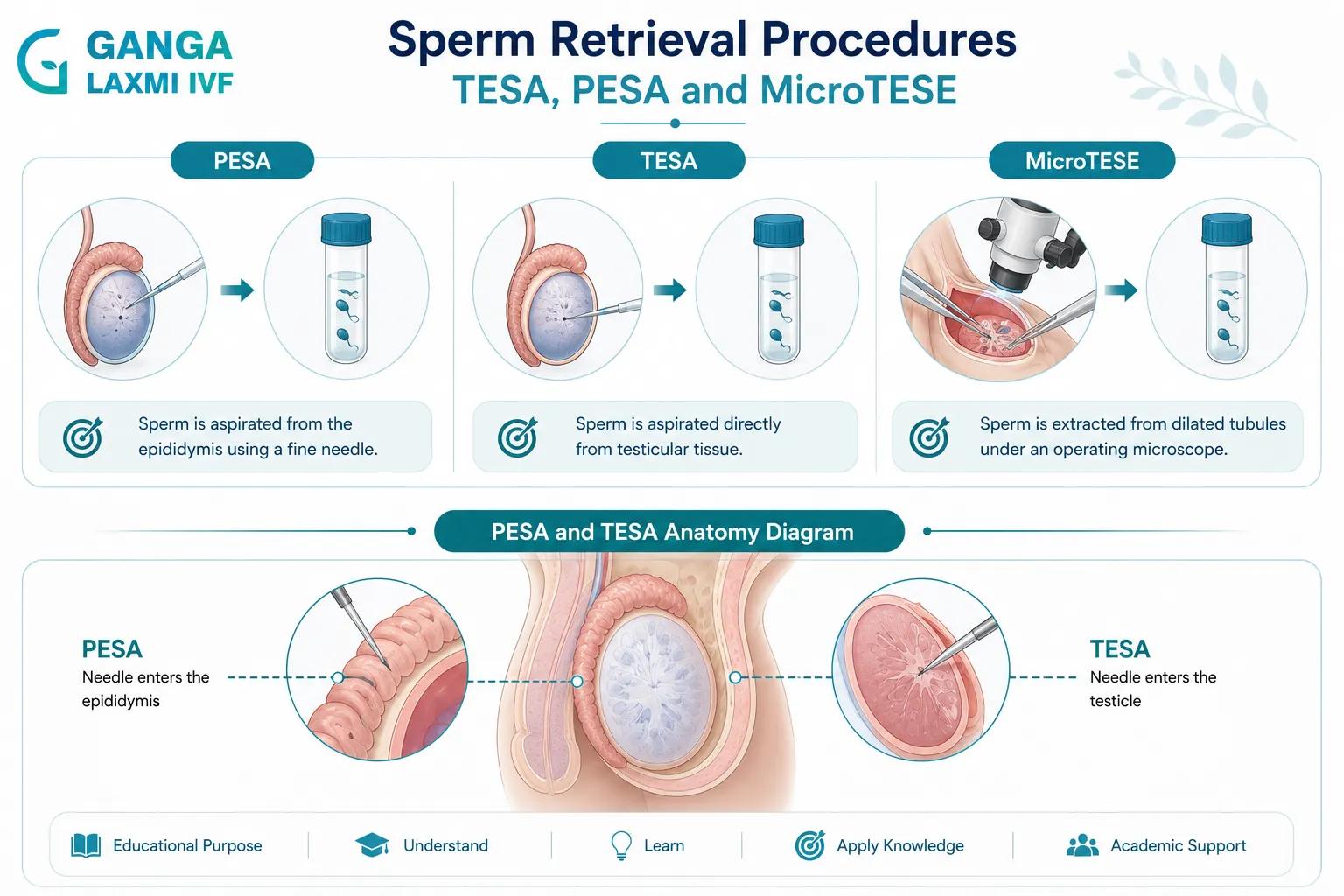
TESA and PESA use a fine needle to draw sperm from the testicle or epididymis and are typically used for obstructive azoospermia. MicroTESE opens the testicle under an operating microscope to find isolated pockets of sperm production and gives the highest retrieval odds in non-obstructive azoospermia.
Once the type of azoospermia is confirmed, the next question is almost always the same: where do we find the sperm, and how do we get to them safely? These are the three procedures we use, and each is chosen for a specific situation rather than applied to everyone.
PESA
Full Name
Percutaneous Epididymal Sperm Aspiration
How It Works
A fine needle draws mature sperm stored in the epididymis, the coiled tube that sits next to the testicle
Best Suited For
Obstructive azoospermia, especially after a vasectomy or in men with CBAVD
TESA
Full Name
Testicular Sperm Aspiration
How It Works
A fine needle is passed into the testicle to draw sperm out directly from the tissue
Best Suited For
Obstructive azoospermia, and select non-obstructive cases with patchy sperm production
MicroTESE
Full Name
Microsurgical Testicular Sperm Extraction
How It Works
The testicle is opened under an operating microscope so that larger, more active sperm-producing tubules can be identified and sampled precisely
Best Suited For
Non-obstructive azoospermia, where production is scattered and unpredictable. This gives the highest retrieval odds in these cases
| Procedure | Full Name | How It Works | Best Suited For |
|---|---|---|---|
| PESA | Percutaneous Epididymal Sperm Aspiration | A fine needle draws mature sperm stored in the epididymis, the coiled tube that sits next to the testicle | Obstructive azoospermia, especially after a vasectomy or in men with CBAVD |
| TESA | Testicular Sperm Aspiration | A fine needle is passed into the testicle to draw sperm out directly from the tissue | Obstructive azoospermia, and select non-obstructive cases with patchy sperm production |
| MicroTESE | Microsurgical Testicular Sperm Extraction | The testicle is opened under an operating microscope so that larger, more active sperm-producing tubules can be identified and sampled precisely | Non-obstructive azoospermia, where production is scattered and unpredictable. This gives the highest retrieval odds in these cases |
All three procedures are performed under local anaesthesia or light sedation, take well under an hour, and are done as a day case. Most men go home the same day with mild soreness for a day or two and are back to normal activity within 48 hours.
Whether MicroTESE is better than TESA depends entirely on the type of azoospermia. For obstructive azoospermia, a standard TESA or PESA is usually sufficient, since sperm production is normal and the only issue is a blockage. For non-obstructive azoospermia, MicroTESE consistently retrieves sperm at higher rates than a standard needle biopsy, because the microscope lets the surgeon identify and sample the specific tubules most likely to contain sperm rather than sampling blindly.
7. Zero Sperm Count vs Low Sperm Count: What Is the Difference?
These two diagnoses are often confused, but they lead to different first steps in treatment even though both usually rely on ICSI at the fertilisation stage.
What the semen analysis shows
Zero Sperm Count (Azoospermia)
No sperm visible, even after the sample is centrifuged and re-examined
Low Sperm Count (Oligospermia)
Sperm are present, but the concentration is below the normal reference range
First step in treatment
Zero Sperm Count (Azoospermia)
Surgical sperm retrieval (TESA, PESA or MicroTESE) is usually required before fertilisation can be attempted
Low Sperm Count (Oligospermia)
Sperm from the ejaculated sample can often be used directly, sometimes after lab processing to concentrate the healthiest sperm
Fertilisation method
Zero Sperm Count (Azoospermia)
Almost always ICSI, since retrieved sperm numbers are typically very low
Low Sperm Count (Oligospermia)
IUI for mild cases, IVF or ICSI for more significant reductions in count
Natural conception
Zero Sperm Count (Azoospermia)
Not possible unless an obstructive cause is surgically corrected
Low Sperm Count (Oligospermia)
Sometimes still possible, especially with mild reductions and a fertile female partner, though it can take longer
| Factor | Zero Sperm Count (Azoospermia) | Low Sperm Count (Oligospermia) |
|---|---|---|
| What the semen analysis shows | No sperm visible, even after the sample is centrifuged and re-examined | Sperm are present, but the concentration is below the normal reference range |
| First step in treatment | Surgical sperm retrieval (TESA, PESA or MicroTESE) is usually required before fertilisation can be attempted | Sperm from the ejaculated sample can often be used directly, sometimes after lab processing to concentrate the healthiest sperm |
| Fertilisation method | Almost always ICSI, since retrieved sperm numbers are typically very low | IUI for mild cases, IVF or ICSI for more significant reductions in count |
| Natural conception | Not possible unless an obstructive cause is surgically corrected | Sometimes still possible, especially with mild reductions and a fertile female partner, though it can take longer |
8. How ICSI Turns a Few Retrieved Sperm Into a Pregnancy
Retrieval on its own does not create a pregnancy. The number of sperm recovered through TESA, PESA or MicroTESE is often very small, sometimes only a few dozen, which rules out natural conception and even standard IVF treatment, where thousands of motile sperm are needed to fertilise a single egg on their own. This is where ICSI, Intracytoplasmic Sperm Injection, becomes essential. A single healthy sperm is all ICSI needs for each egg.
- Retrieval and egg collection are timed together. Wherever possible, sperm are retrieved from the male partner on the same day the female partner's eggs are collected, so fresh sperm can be used immediately.
- The embryologist examines the retrieved tissue or fluid under high magnification and identifies viable sperm, even when the sample looks, to the naked eye, like almost nothing at all.
- A single sperm is picked up on a fine glass needle and injected directly into the centre of each mature egg.
- Fertilised eggs are cultured in the laboratory for three to five days.
- The healthiest resulting embryo is transferred into the uterus, exactly as in any other IVF cycle.
If retrieval yields very few sperm, they can also be frozen for future cycles, so a single surgical retrieval does not have to mean a single attempt at pregnancy.
9. The Complete Treatment Pathway for Azoospermia at Ganga Laxmi IVF
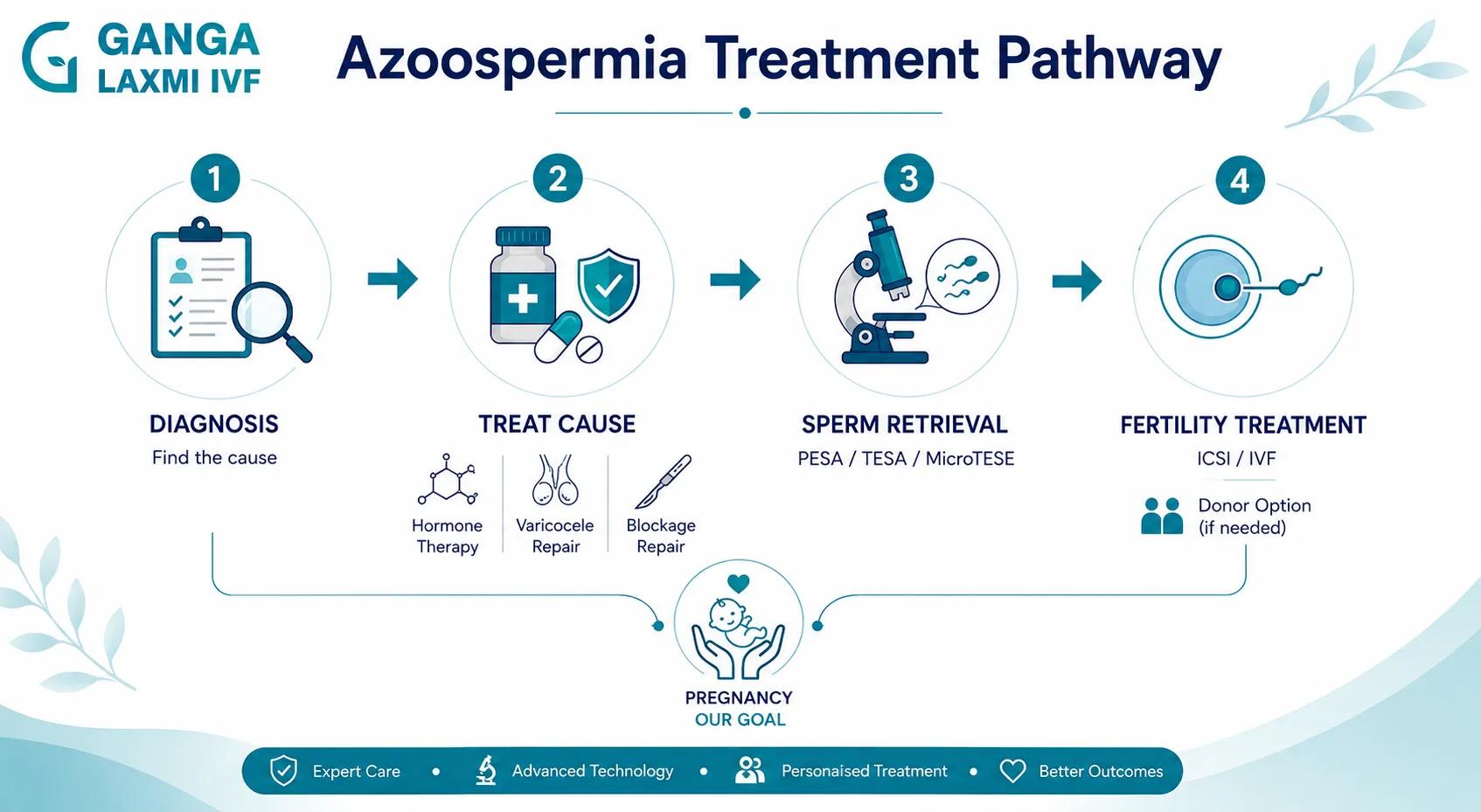
I do not take every man straight to surgery. Treatment is staged, starting with whatever is least invasive and most likely to work for the specific cause found on your male infertility evaluation.
Step 1 — Identify and treat a reversible cause: hormone therapy for a pituitary or hormonal cause, surgical repair for a varicocele
Approach
Identify and treat a reversible cause: hormone therapy for a pituitary or hormonal cause, surgical repair for a varicocele
When It Applies
Non-obstructive cases where an identifiable, reversible cause is found
Step 2 — Reconstructive surgery: vasectomy reversal, vaso-epididymostomy, or correction of a known blockage
Approach
Reconstructive surgery: vasectomy reversal, vaso-epididymostomy, or correction of a known blockage
When It Applies
Obstructive cases where the anatomy allows repair. Can restore natural conception without needing IVF at all
Step 3 — Sperm retrieval combined with ICSI: PESA, TESA or MicroTESE, coordinated with the IVF cycle
Approach
Sperm retrieval combined with ICSI: PESA, TESA or MicroTESE, coordinated with the IVF cycle
When It Applies
Most obstructive cases, and non-obstructive cases where retrieval is likely to succeed
Step 4 — Donor sperm, used with IUI or IVF
Approach
Donor sperm, used with IUI or IVF
When It Applies
When no sperm are found despite a thorough surgical search, discussed only with the couple's full understanding and consent
| Step | Approach | When It Applies |
|---|---|---|
| 1 | Identify and treat a reversible cause: hormone therapy for a pituitary or hormonal cause, surgical repair for a varicocele | Non-obstructive cases where an identifiable, reversible cause is found |
| 2 | Reconstructive surgery: vasectomy reversal, vaso-epididymostomy, or correction of a known blockage | Obstructive cases where the anatomy allows repair. Can restore natural conception without needing IVF at all |
| 3 | Sperm retrieval combined with ICSI: PESA, TESA or MicroTESE, coordinated with the IVF cycle | Most obstructive cases, and non-obstructive cases where retrieval is likely to succeed |
| 4 | Donor sperm, used with IUI or IVF | When no sperm are found despite a thorough surgical search, discussed only with the couple's full understanding and consent |
10. What Is the Cost of Azoospermia Treatment in Lucknow?
There is no single, fixed price for azoospermia treatment, because the cost depends on how many steps your specific diagnosis actually requires. It is built up from several possible components rather than one flat fee.
Initial evaluation and semen analysis
What Determines the Cost
Number of repeat tests needed to confirm the diagnosis
Hormonal and genetic testing
What Determines the Cost
Whether karyotyping or Y-chromosome microdeletion testing is recommended for non-obstructive cases
Sperm retrieval procedure
What Determines the Cost
Whether PESA, TESA or the more involved MicroTESE is required, and whether it is combined with the egg retrieval visit
ICSI and IVF cycle
What Determines the Cost
Medication protocol, number of eggs retrieved, and laboratory charges for the ICSI procedure itself
Reconstructive surgery, if applicable
What Determines the Cost
Complexity of the blockage and whether it is a day procedure or requires a longer recovery
| Component | What Determines the Cost |
|---|---|
| Initial evaluation and semen analysis | Number of repeat tests needed to confirm the diagnosis |
| Hormonal and genetic testing | Whether karyotyping or Y-chromosome microdeletion testing is recommended for non-obstructive cases |
| Sperm retrieval procedure | Whether PESA, TESA or the more involved MicroTESE is required, and whether it is combined with the egg retrieval visit |
| ICSI and IVF cycle | Medication protocol, number of eggs retrieved, and laboratory charges for the ICSI procedure itself |
| Reconstructive surgery, if applicable | Complexity of the blockage and whether it is a day procedure or requires a longer recovery |
Rather than quote a number that will not apply to your situation, Dr. Chauhan reviews your test results first and then gives a complete, itemised estimate before any procedure begins, so you know exactly what you are paying for and why. A first consultation to discuss your semen analysis and options is available from Rs. 400.
11. What Actually Decides Your Chances of Success
- The type of azoospermia: obstructive cases have a more predictable, generally higher chance of successful retrieval than non-obstructive cases.
- The underlying cause: some causes, like a hormone deficiency or varicocele, are directly treatable; others, like advanced testicular failure, are not.
- Testicle size and FSH level, which give a rough, though not absolute, prediction of retrieval odds in non-obstructive azoospermia.
- Whether a microsurgical technique such as MicroTESE is used for non-obstructive cases, since it consistently outperforms a standard needle biopsy for finding scattered pockets of sperm production.
- The female partner's age and ovarian reserve, since ICSI still depends on the quality of the egg it fertilises.
- The experience of the embryology laboratory in identifying and handling very low numbers of sperm, where a small technical difference in skill can be the difference between a viable embryo and none.
12. Why Men in Lucknow Choose Ganga Laxmi IVF for Azoospermia Treatment
A full diagnostic workup before any surgery is recommended
What It Means for You
You are never rushed into a retrieval procedure without first knowing your type of azoospermia and its likely cause
TESA, PESA and sperm retrieval are coordinated with the IVF cycle
What It Means for You
Retrieved sperm can be used fresh for ICSI on the same day wherever possible, avoiding unnecessary freeze-thaw steps and extra procedures
Genetic counselling is offered for non-obstructive cases
What It Means for You
Karyotyping and Y-chromosome microdeletion testing are discussed before surgery, so you understand what a finding could mean for a future child, not after
An honest prognosis rather than blanket optimism
What It Means for You
Dr. Chauhan explains the real retrieval odds for your specific cause before you commit to any procedure or cost
Confidential, judgement-free consultations
What It Means for You
Many men come to their first appointment alone, before involving their partner. That is entirely welcome
| What We Do | What It Means for You |
|---|---|
| A full diagnostic workup before any surgery is recommended | You are never rushed into a retrieval procedure without first knowing your type of azoospermia and its likely cause |
| TESA, PESA and sperm retrieval are coordinated with the IVF cycle | Retrieved sperm can be used fresh for ICSI on the same day wherever possible, avoiding unnecessary freeze-thaw steps and extra procedures |
| Genetic counselling is offered for non-obstructive cases | Karyotyping and Y-chromosome microdeletion testing are discussed before surgery, so you understand what a finding could mean for a future child, not after |
| An honest prognosis rather than blanket optimism | Dr. Chauhan explains the real retrieval odds for your specific cause before you commit to any procedure or cost |
| Confidential, judgement-free consultations | Many men come to their first appointment alone, before involving their partner. That is entirely welcome |
Confidential consultation
All consultations regarding azoospermia and male factor infertility at Ganga Laxmi IVF are completely confidential. A clear, private conversation about your semen analysis results, spread over as much time as you need, is often the most useful first step.
13. Frequently Asked Questions
These are the questions I am asked most often by men and couples facing an azoospermia diagnosis. I have answered each one as I would in a consultation.
Not necessarily. Many men with azoospermia go on to father biological children through sperm retrieval combined with ICSI, or in some cases through reconstructive surgery alone. The first step is a full evaluation to determine whether the cause is obstructive or non-obstructive, since that distinction changes everything about your outlook.
TESA and PESA are performed under local anaesthesia or mild sedation. Most patients describe mild discomfort during the procedure and some soreness for a day or two afterward, similar to a minor dental procedure rather than major surgery. Most men return to normal activity within 48 hours.
Azoospermia means no sperm are seen even after the sample has been centrifuged and re-examined. A very low sperm count, called severe oligospermia, means some sperm are present but in very small numbers. Both conditions usually need ICSI to achieve fertilisation, but azoospermia additionally requires a surgical sperm retrieval procedure first, since there is nothing to collect from an ejaculated sample.
This depends on how long ago the vasectomy was done, your partner's age, and your family planning goals. A reversal can restore natural conception and allow more than one pregnancy without further surgery, but it takes several months before you know whether it has worked. Retrieval combined with ICSI has a more predictable timeline and can proceed alongside the female partner's IVF cycle. Dr. Chauhan discusses both options and their trade-offs based on your specific situation before you decide.
Some causes of non-obstructive azoospermia, such as a Y-chromosome microdeletion, can potentially be passed on to a son conceived this way. This is exactly why karyotyping and genetic counselling are recommended before surgery in non-obstructive cases. Where a hereditary cause is confirmed, options such as Preimplantation Genetic Testing can be discussed before an embryo is transferred.
The total cost depends on which sperm retrieval procedure is needed, whether genetic testing is recommended, and the details of the IVF and ICSI cycle itself. Dr. Chauhan provides a complete, itemised estimate at your consultation before any procedure begins, with no hidden charges. A first consultation to discuss your semen analysis and options is available from Rs. 400.
In a small proportion of men, a thorough surgical search still finds no sperm. In this situation, donor sperm is an option that Dr. Chauhan discusses with complete confidentiality. No couple is left without a path forward, and the decision is always made together, with time to consider it properly.
The embryologist examines the retrieved tissue or fluid under the microscope on the same day, usually while you are still recovering from the procedure. In most cases you will know within a few hours whether viable sperm were found.
Chronic stress can lower testosterone and disrupt the hormonal signals involved in sperm production, and it is a recognised contributing factor in some cases of reduced sperm count. However, stress alone does not cause true azoospermia in a man with otherwise normal anatomy and genetics. If your evaluation points to a hormonal or structural cause, that needs to be addressed directly rather than treated as a stress-related issue.
It depends entirely on the cause. Obstructive azoospermia is often correctable with surgery, after which sperm can reappear in the semen. Non-obstructive azoospermia caused by a hormonal deficiency can sometimes resolve with several months of hormone therapy. Azoospermia caused by advanced testicular failure or certain genetic conditions is generally permanent, though sperm may still be retrievable directly from testicular tissue even when none appear in the ejaculate.
In specific situations, yes. Hormonal medication can restore sperm production in men with a pituitary or hormonal cause of azoospermia, and this is one of the more reliably effective medical treatments available. Medication is not effective for a mechanical blockage or most genetic causes, which is why an accurate diagnosis has to come before any prescription.
Azoospermia is typically managed jointly by a fertility specialist or reproductive endocrinologist and, where surgery is needed, a urologist or andrologist. At Ganga Laxmi IVF, Dr. Chauhan coordinates the full diagnostic workup, treatment planning, sperm retrieval, and the IVF or ICSI cycle, so you are not passed between multiple clinics for each step.
For obstructive azoospermia, standard TESA or PESA is usually sufficient, since sperm production is normal and only a blockage needs to be bypassed. For non-obstructive azoospermia, MicroTESE generally retrieves sperm at higher rates than a standard needle biopsy, because the operating microscope allows the surgeon to identify and sample the specific areas of the testicle most likely to contain sperm.
A balanced diet with adequate zinc, folate and antioxidants supports general reproductive health, and correcting deficiencies where they exist can help in mild, reversible cases. However, no food or supplement will resolve a physical blockage or most genetic causes of azoospermia. Treat nutrition as a supporting measure alongside medical evaluation, not as a substitute for it.
You Do Not Have to Face a Zero Sperm Count Alone
A semen report showing no sperm is a starting point for a proper investigation, not a final verdict on your future as a father. Whether the cause turns out to be a simple blockage or something more complex, the path from that report to a real treatment plan is shorter than most men expect, and you do not have to walk it without answers.
If you would like a clear, confidential and honest assessment of your semen analysis and your options, I would like to help.
About the author
Dr. Kumudini Chauhan
Dr. Kumudini Chauhan
IVF & fertility
Dr. Chauhan is a senior gynaecologist and infertility specialist in Gomti Nagar, Lucknow with over 20 years of experience. She is dedicated to providing honest, evidence-based guidance to couples navigating fertility challenges.
Keep reading
Related articles
Blocked Fallopian Tube Treatment in Lucknow: Causes, HSG Test, IVF & Pregnancy Options
Blocked fallopian tubes are a leading cause of female infertility. Dr. Kumudini Chauhan explains causes, HSG testing and IVF options in Lucknow.
Black Period Blood: Causes, Symptoms, Treatment and When to See a Doctor
Black period blood is usually harmless old blood, but it can signal PCOS, low estrogen or an infection. Know the causes, warning signs & when to consult a gynaecologist in Lucknow.

Kangaroo Mother Care (KMC): A Simple Yet Powerful Way to Save Newborn Lives
What is Kangaroo Mother Care? Learn how skin-to-skin contact saves premature babies, improves breastfeeding, and supports growth. A complete KMC guide.
IVF After a Failed Cycle: What to Do Next, and Why It Still Works
A failed IVF cycle does not mean the end. Dr. Kumudini Chauhan, Lucknow, explains what causes failure, what changes for the next cycle, and why many patients succeed after one setback.